
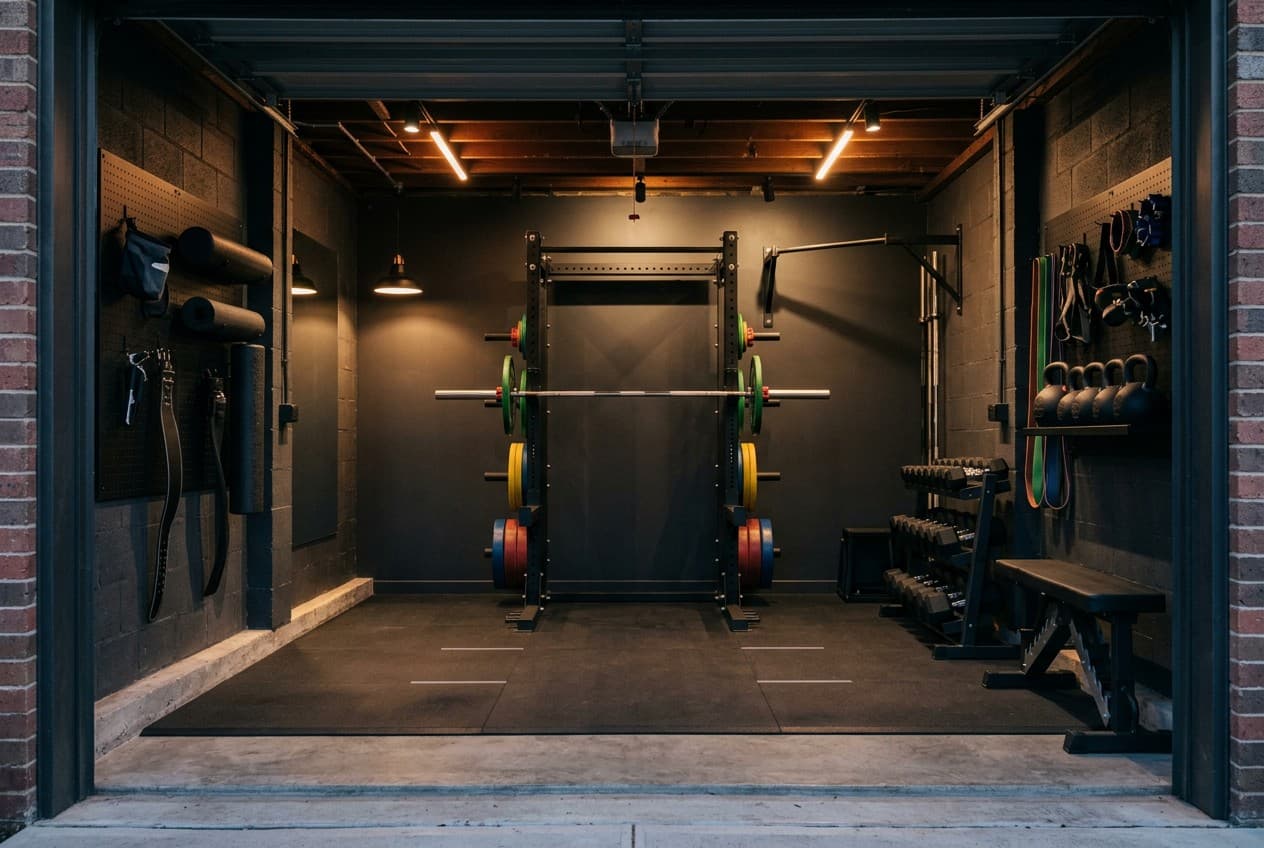
Why Your Garage Is the Best Gym You'll Ever Build
Commercial gyms charge $30–$80/month. You wait for equipment. You work around other people's schedules. A garage gym costs more upfront but gives you something no commercial gym can: equipment you can use anytime, configured exactly for how you train.
The problem most people hit: they buy equipment without a plan. The barbell arrives, takes up more room than expected, the rack goes in the wrong spot, and suddenly the garage is full of equipment that doesn't quite work together. Training suffers. The car stays in the driveway permanently.
The fix is zone planning before equipment purchasing. This guide gives you the layouts, the dimensions, and the budget tiers to plan your garage gym the right way.
Core Zone Planning Principles
Before you choose a single piece of equipment, map your zones. A functional garage gym needs at least three:
- Lifting zone — where the rack, barbell, and plates live. Must have overhead clearance (min. 8 ft, ideally 9+ ft), and adequate side clearance for Olympic bar (7.2 ft minimum between walls).
- Cardio zone — treadmill, rower, or bike. Can be folded/stored vertically in small garages when not in use.
- Movement/floor zone — open space for stretching, bodyweight work, warmup. Often neglected, always regretted when absent.
Optional (but valuable in larger garages):
- Storage zone — plates, dumbbells, resistance bands, accessories
- Recovery zone — foam roller, stretching mat, bench away from main lift area
1-Car Garage Gym Layout
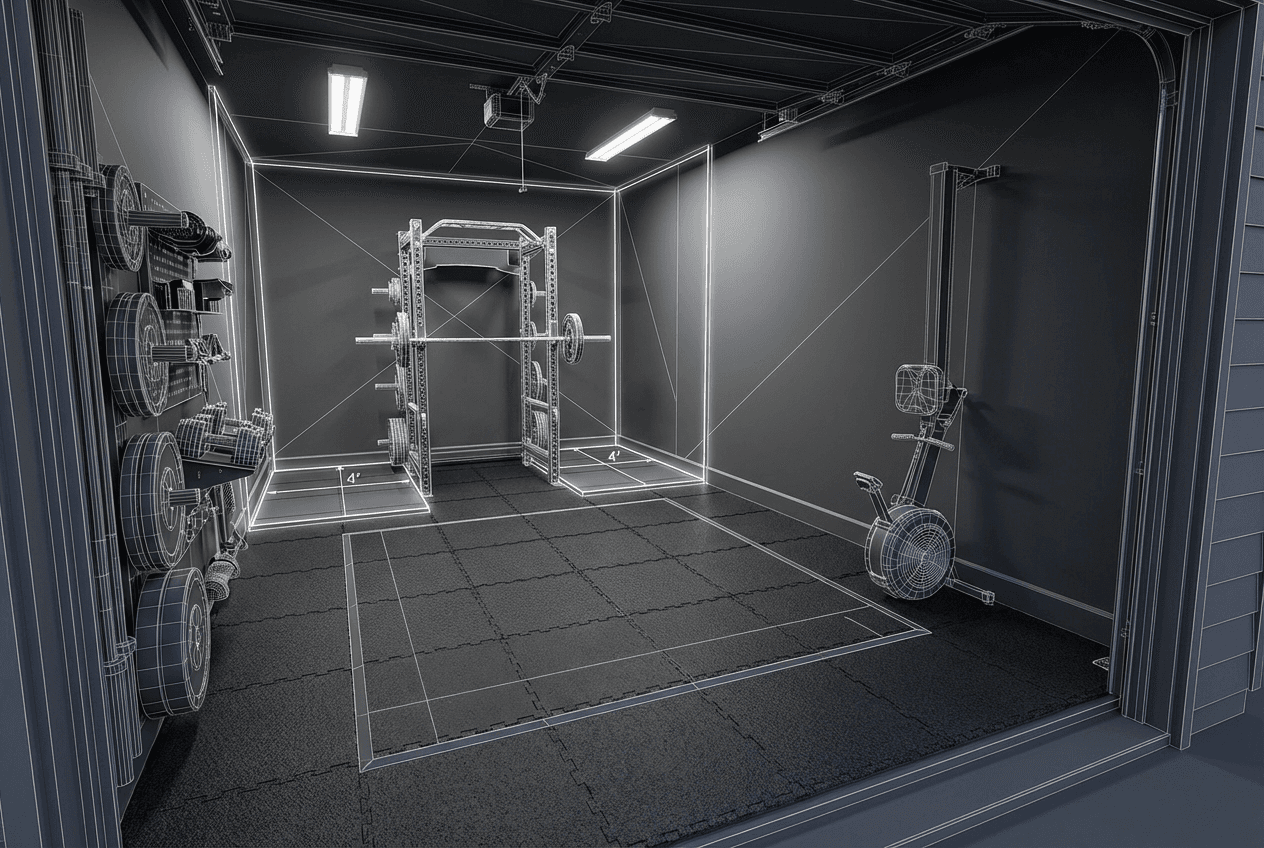
A single-car garage (typically 12×20 ft, 240 sq ft) can house a fully functional gym. You won't fit everything — but you can fit everything you actually need.
1-Car Garage Gym (12×20 ft)
Total: 240 sq ft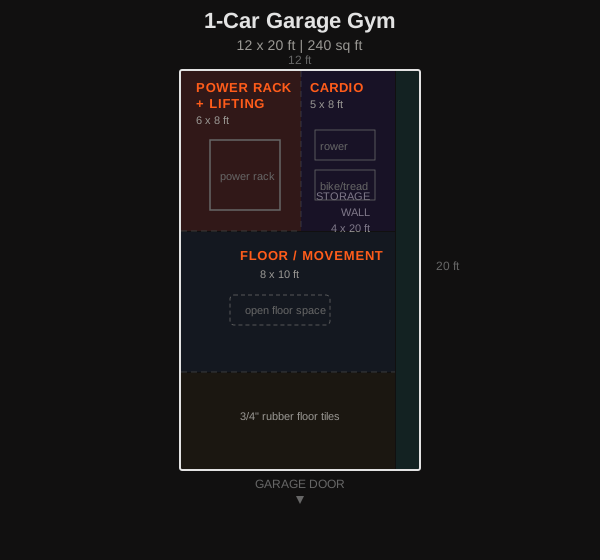
What makes the 1-car layout work:
- Rack in the corner (uses dead space, keeps center open)
- Cardio equipment that folds or stands vertically when not in use
- All weight storage on the wall, not floor-mounted trees in the middle of the space
- Rubber flooring throughout (not just under the rack)
Measurements that determine whether your equipment fits before you buy it.
2-Car Garage Gym Layout
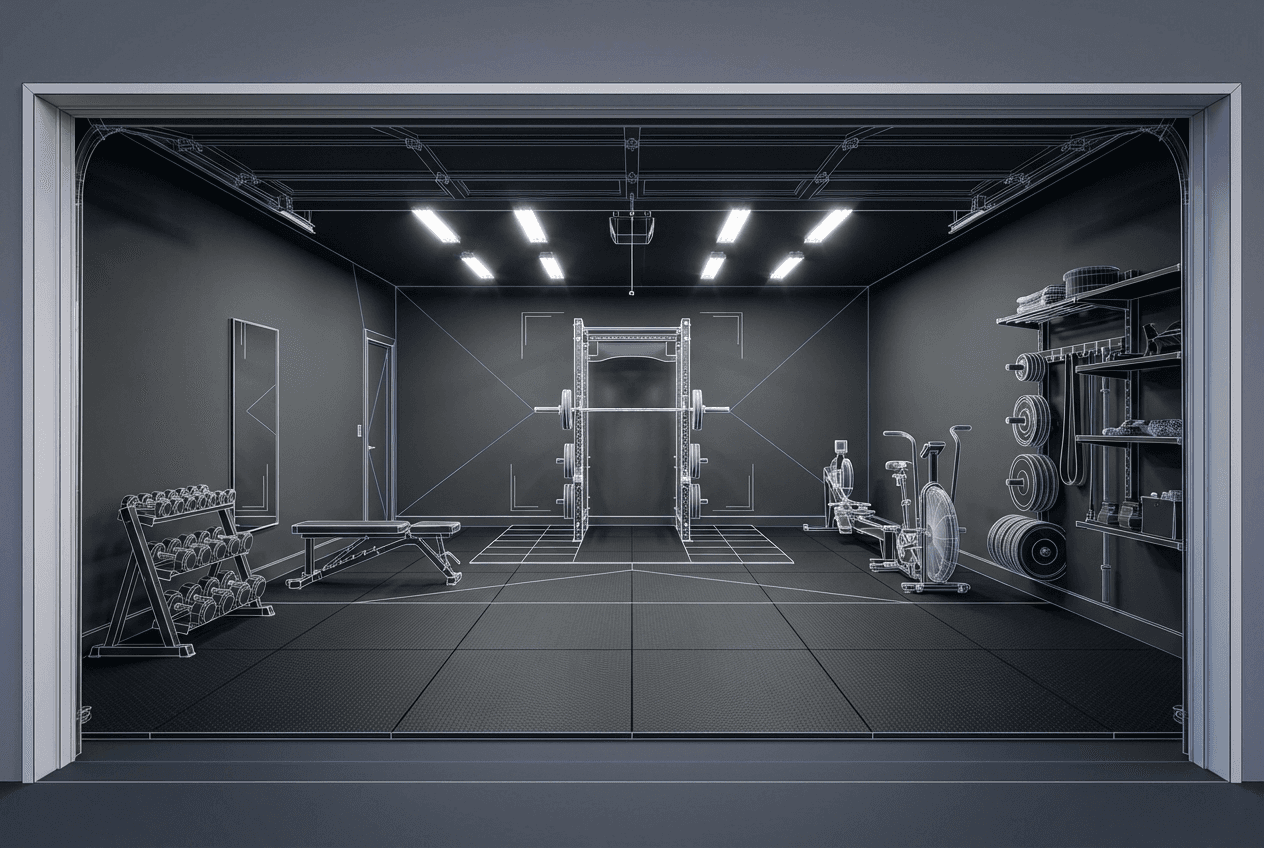
A 2-car garage (typically 20×22 ft, 440 sq ft) gives you room to be ambitious. Most people configure this one of two ways: full gym (no car), or hybrid gym + vehicle.
2-Car Garage Full Gym (20×22 ft)
Total: 440 sq ft2-Car Hybrid (One Bay Gym, One Bay Car)
Total: 440 sq ftEquipment Checklist by Training Style
Garage Gym Equipment — Priority by Training Goal
| Tool / Item | Use | Est. Cost | Priority |
|---|---|---|---|
| Power Rack / Squat Stand | Barbell squats, bench press, overhead press — the anchor of any weight room | $400–$1,200 | Essential |
| Olympic Barbell + Plates | Foundation of strength training. Get 300 lb minimum (bar + plates) | $250–$600 | Essential |
| Rubber Flooring | Protects floor, protects you, reduces noise. 3/4 inch minimum for lifting | $200–$600 | Essential |
| Adjustable Bench | Flat, incline, and decline pressing. Folds for storage in small garages | $150–$400 | Essential |
| Bumper Plates | Required for Olympic lifts and deadlifts near the floor. Not strictly needed for standard lifting | $200–$500 | Recommended |
| Adjustable Dumbbells | Replaces a full dumbbell rack. Essential for accessory work, cardio, and unilateral training | $200–$400 | Recommended |
| Pull-Up Bar / Rig | Horizontal pull strength. Many racks include this — check before buying separately | $30–$200 | Recommended |
| Cardio Equipment | Rower preferred for small spaces (compact, full-body). Assault bike second. Treadmill last (large footprint) | $500–$2,000 | Recommended |
| Resistance Bands | Warm-up, mobility, accessory work. Takes zero space. No reason not to own them. | $20–$60 | Optional |
| Mirror | Form check and visual feedback. Wall-mounted. More useful than most people expect. | $80–$250 | Optional |
| Gymnastics Rings | Mounted to ceiling or rack. Ring dips, muscle-ups, body rows. High value, low cost. | $30–$80 | Optional |
Budget Tiers
Garage Gym Budget Tiers
- Squat stand (not full rack) + barbell + 200 lb plates
- Adjustable bench
- Basic rubber mats (partial coverage)
- Adjustable dumbbells
- Trade-off: limited overhead press safety, no spotter arms
- Full power rack with j-hooks and safeties
- 300 lb Olympic barbell + plate set
- Full rubber floor coverage (3/4 inch)
- Adjustable bench + adjustable dumbbells
- Rower or assault bike
- Commercial-grade power rack (Rogue, Sorinex)
- Full bumper plate set + calibrated plates
- Epoxy floor + premium rubber tiles
- Multiple cardio machines
- Dumbbell rack + full dumbbell set
- Mirror wall + lighting upgrade
Frequently Asked Questions
Can a garage gym replace a commercial gym?
For most training goals, yes. Powerlifting, strength training, bodybuilding, and general fitness are all completely achievable in a garage gym. Where it falls short: certain cardio machines, specialty equipment (cable machines, leg press), and the social/coaching element some people rely on.
How do I keep the garage gym usable in winter and summer?
Insulation is the key investment. Even basic wall and ceiling insulation makes a garage 15–20°F more comfortable in both directions. Add a dedicated mini-split for year-round temperature control ($800–$2,000 installed). A basic portable AC and space heater work as a budget alternative but aren't energy-efficient long-term.
What flooring should I use?
For lifting: 3/4 inch interlocking rubber tiles or rolls. Not foam — it compresses too much under heavy loads and is a stability risk during pressing movements. See our Garage Gym Flooring Guide for a full comparison.
Do I need a permit to build a garage gym?
Usually no, if you're just installing equipment and flooring. If you're adding electrical (for HVAC or cardio machines), adding walls, or modifying plumbing, permits may be required. Check local building codes before any structural modifications.
Next Steps
The layout and equipment decisions are the fun part. The unsexy part — flooring, climate control, power access — determines whether the gym actually gets used.
Start with the flooring. Then the rack. Everything else can be added over time.
- Garage Gym Flooring Guide — rubber vs foam vs stall mats, fully compared
- Garage Gym Setup on a Budget — how to prioritize when money is the constraint
- Garage Gym Hub: Complete Guide — the full garage gym planning resource
Use the AI Garage Designer to get a custom layout for your specific garage dimensions, training goals, and budget.