
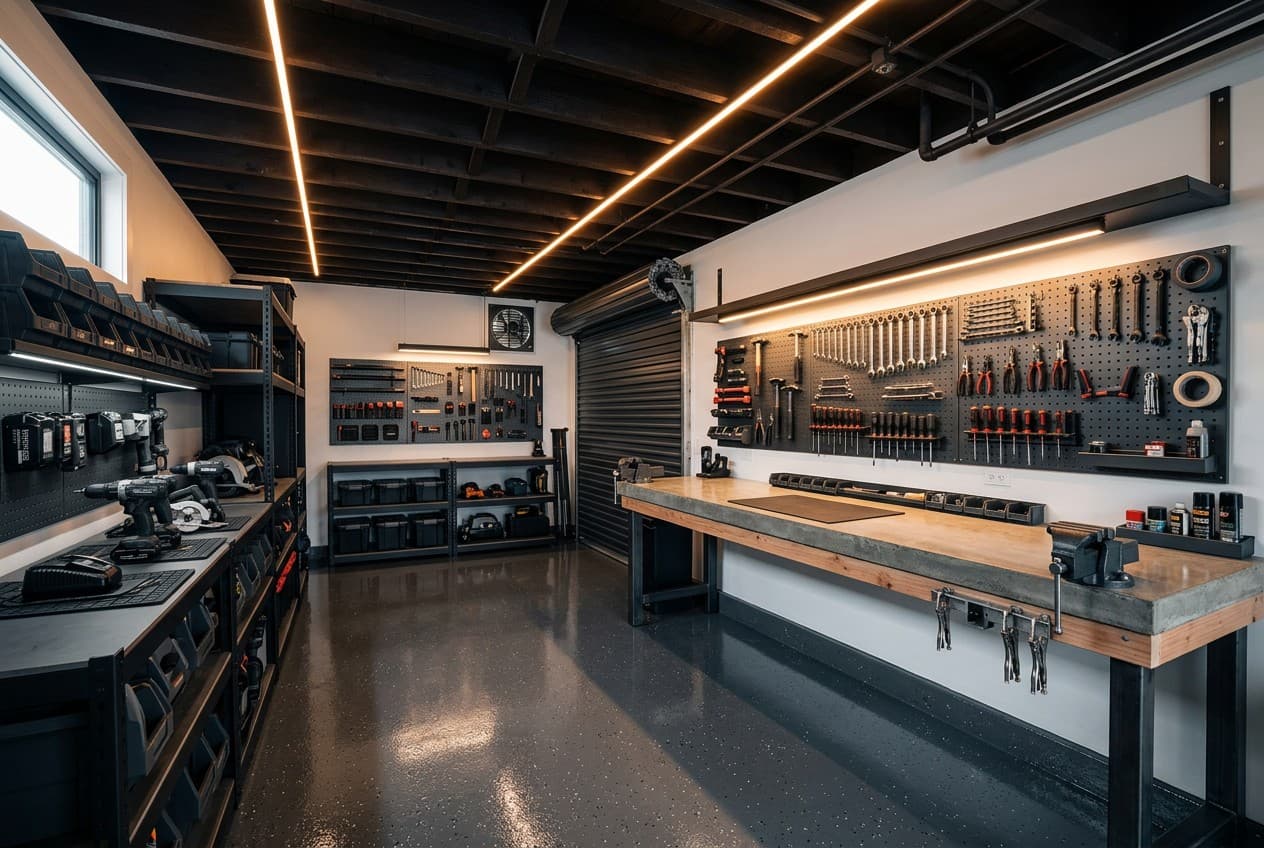
What Is a Garage Makeover — and Is It Worth It?
A garage makeover is the process of transforming an underused, cluttered, or purely functional garage into a space you actually want to spend time in. Whether you're aiming for a clean organised space, a proper workshop, a man cave, or a home gym, the principles are the same: plan first, build the structure, then add the finishes.
As a mechanical engineer with over a decade of hands-on construction experience, I've seen homeowners waste thousands on makeovers that didn't deliver because they skipped the planning stage. This guide walks you through every step — from taking measurements to the final coat of paint.
Is a garage makeover worth it? Almost always yes. A well-executed garage makeover can add $5,000–$20,000 in home value, dramatically improve daily usability, and create a space that pays for itself in hobby, fitness, or remote work productivity.
In This Guide
Step 1: Define Your Garage's Primary Purpose
Before you buy a single shelving unit or paint sample, you need to answer one question: what is this garage actually for?
The most common transformation goals are:
| Goal | Key Requirements | Budget Range |
|---|---|---|
| Clean & Organised Storage | Wall systems, overhead racks, floor treatment | $500–$3,000 |
| Home Workshop | Workbench, tool storage, power circuits, lighting | $2,000–$10,000 |
| Man Cave / Entertainment | Insulation, drywall, bar, AV setup | $5,000–$20,000 |
| Home Gym | Rubber flooring, equipment, ventilation | $2,000–$8,000 |
| She Shed / Creative Space | Insulation, lighting, custom storage, décor | $2,000–$12,000 |
| Backyard Office | Full insulation, electrical, HVAC, connectivity | $8,000–$30,000 |
The single biggest mistake I see homeowners make is trying to do everything at once — a workshop and a gym and a place for the car. Pick a primary use. Secondary uses can coexist, but the primary use should drive every decision.
Use the AI Garage Designer to upload a photo of your current space and get a personalised transformation plan based on your specific goals and budget.
Step 2: Assess What You're Working With
Before planning, document your existing space:
Measure everything:
- Overall dimensions (width × depth × ceiling height)
- Door locations and swing direction (note clearances)
- Window positions and sizes
- Location of electrical panel, outlets, and any existing circuits
- Water entry points and drainage
How Long Will This Take?
| Project Scope | Realistic Timeline | Notes |
|---|---|---|
| Storage cleanup + basic organising | 1–2 weekends | No trades needed; can start immediately |
| Mid-range refresh (epoxy + wall storage + lighting) | 2–4 weeks | Epoxy needs 3–5 days cure time; wall systems 1–2 days install |
| Full makeover (insulation + HVAC + drywall + electrical) | 6–12 weeks | Add 2–4 weeks for contractor scheduling; 1–2 weeks for material lead times (garage doors, custom cabinets) |
| Living space conversion (gym, office, man cave) | 8–16 weeks | Permits add 2–6 weeks in many jurisdictions; HVAC install is the longest single trade |
Most delays come from three sources: permit processing (2–6 weeks in busy municipalities), material lead times (insulated garage doors can take 4–8 weeks), and contractor availability. Budget your timeline with a 20% buffer.
Identify problems to solve:
- Moisture intrusion (check for efflorescence on walls, staining on floor)
- Poor lighting (most garages are criminally under-lit)
- Lack of insulation (critical for usable temperature range)
- No outlets near where you'd work
- Concrete floor condition (cracks, oil stains, unevenness)
Inventory what's staying:
- Which items genuinely need to live in the garage vs. items that have drifted there over time
- Most homeowners can eliminate 30–40% of garage contents before the makeover even starts
Step 3: Plan the Layout
Good garage layout design follows the same principles as kitchen design: work triangle, zone separation, clear circulation paths.
The Three-Zone Approach
Zone 1 — Active Work Area: The floor space where you actually do things. Keep this clear, central, and accessible. For a workshop, this is bench space and machine footprint. For a gym, it's your workout floor. For a garage, it may just be parking.
Zone 2 — Storage: Wall-mounted and overhead systems that keep Zone 1 clear. Rule of thumb: get everything off the floor and onto the walls. A standard 2-car garage (20×20 ft) has approximately 160 linear feet of wall space — most of which sits empty in an unimproved garage.
Zone 3 — Utility: Electrical panel, HVAC, water heater, any fixed services. Plan around these — don't fight them.
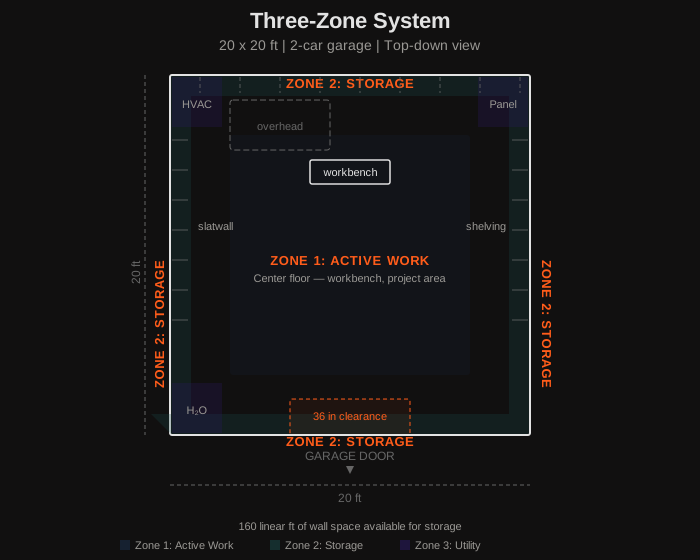
Sketch It Out
You don't need CAD software. A simple grid paper sketch with walls, doors, windows, and fixed services marked is enough to start planning. Mark the clearance zones around doors (typically 36 inches).
Step 4: Tackle the Floor First
The floor is your largest surface and sets the tone for everything else. Do it first — before you bring in any storage or furniture — because most flooring treatments require a clear floor.
Option 1: Epoxy Coating (Best Value)
Cost: $2–$6/sq ft DIY, $4–$10/sq ft professional Durability: 5–10 years DIY, 10–20 years professional Best for: Most garages — clean look, oil and chemical resistant
Epoxy is the workhorse of garage flooring. A proper 2-part epoxy system (not the one-part paint from a big-box store) creates a durable, chemical-resistant surface that's easy to clean and looks excellent.
The key steps DIYers miss:
- Acid etch or mechanical grind the concrete before application (skipping this causes peeling)
- Check and address moisture — epoxy fails on wet concrete
- Apply in the right temperature range (typically 50–90°F)
Products to consider:
Option 2: Interlocking Floor Tiles
Cost: $1.50–$5/sq ft Durability: 10–20 years Best for: Gyms, showrooms, areas where DIY installation speed matters
Polypropylene interlocking tiles snap together in hours with no adhesive. They're removable, comfortable underfoot, and available in dozens of colours and patterns. For a gym transformation, rubber-top tiles are ideal for impact absorption.
Option 3: Polyurea/Polyaspartic Coating
Cost: $8–$15/sq ft (professional only) Durability: 15–25 years Best for: When you want the best, don't want to DIY
Polyurea is the professional-grade upgrade — harder, more UV-stable, and applied in a single day. If you're investing heavily in a space, this is worth the premium.
Step 5: Insulate and Control the Climate
An uninsulated garage is a liability in both summer and winter. Insulation is also one of the highest-return investments in any garage makeover.
Garage Door Insulation
Your garage door is the biggest thermal hole in the envelope. Insulate it first. Most steel garage doors can be retrofitted with rigid foam insulation panels:
- Uninsulated steel door: R-value of ~1
- Insulated door (DIY retrofit): R-value of ~6–10
- Insulated door (factory insulated): R-value of ~8–18
Owens Corning Garage Door Insulation Kit is the most widely available DIY option.
Wall Insulation
For finished garage spaces, fiberglass batts between 2×4 studs give you R-13 to R-15 with minimal cost. If you're planning to drywall anyway, insulating during this step adds very little cost for a significant comfort improvement.
Climate Control Options
| Option | Cost | Best For |
|---|---|---|
| Ceiling fan | $50–$200 | Air circulation, mild climates |
| Portable AC unit | $300–$800 | Cooling, no ducting required |
| Through-wall AC/Heat | $400–$1,500 | Dedicated heating and cooling |
| Mini-split system | $1,500–$4,000 installed | Best efficiency, quiet, year-round |
For any serious workshop or living space, a mini-split heat pump is the gold standard — it handles both heating and cooling, runs efficiently, and doesn't require ducting.
Step 6: Light It Properly
Most garages come with one or two inadequate overhead fixtures. Proper lighting transforms how a space feels and functions.
The general rule: Aim for 50–75 lumens per square foot for a general garage. Workshop areas should hit 100+ lumens per square foot.
For a 400 sq ft (20×20) garage:
- General lighting: 20,000–30,000 lumens total
- Workshop lighting: 40,000+ lumens recommended
LED Shop Light Strips
The easiest and most cost-effective upgrade. 4-foot linkable LED shop lights can be daisy-chained across the ceiling for even coverage.
- Barrina 4ft LED Shop Lights (6-Pack) — a popular choice for whole-garage coverage
- Hyperikon LED Shop Light 4ft
Task lighting: Add dedicated fixtures over the workbench and any stationary machines. A well-lit work surface reduces errors and fatigue.
Step 7: Build the Storage System
Storage is where most garage makeovers win or lose. The goal is to get everything off the floor and make it accessible.
Wall-Mounted Panel Systems
Slatwall or pegboard systems accept a huge variety of hooks, bins, and shelves. They're modular, repositionable, and look clean.
- Gladiator GarageWorks — heavy-duty steel panels, excellent for tool-heavy workshops
- Flow Wall System — lighter duty, cleaner aesthetic, good for mixed-use garages
- French Cleat — DIY-friendly, cheap, infinitely customisable for workshops
Overhead Storage
The ceiling of a 2-car garage has 400 sq ft of space that almost no one uses. Overhead storage racks are the highest-ROI addition per dollar in most garage makeovers.
Fleximounts 4×8 Overhead Garage Storage Rack is the most popular option and for good reason — it's rated to 600 lbs, adjusts in height, and installs in 1–2 hours.
Cabinets
For a finished look, steel or polymer cabinets give you concealed storage for less-frequently accessed items. Key brands:
- Husky (Home Depot exclusive) — good value for most homeowners
- Gladiator — step up in quality, good locking systems
- Kobalt (Lowe's) — comparable to Husky
Step 8: Electrical — What You Actually Need
Most garage makeovers require at minimum some additional electrical work. Plan this early, because rough-in work happens before walls close up.
Minimum circuit additions for most garages:
- Dedicated 20A circuit for power tools or bench area
- Outlet every 6 feet along the workbench wall (vs. every 12 feet in general garage code)
- Exterior outlet on weatherproof GFCI
For workshop builds:
- 240V outlet for table saw, dust collector, or air compressor
- Separate circuit for a mini-split (typically 15–30A depending on unit)
Important: Hire a licensed electrician for any panel work or new circuit additions. DIY electrical that fails inspection creates problems at resale and, more importantly, is a safety risk.
Step 9: Walls and Ceiling Finishing
Once electrical rough-in is complete (if applicable), you can close up walls. For any heated or lived-in space, drywall is the standard. For pure utility garages, painted concrete block or exposed OSB is fine.
Drywall notes for garages:
- Use 5/8" Type X drywall on walls shared with the living space (fire-rated requirement in most US building codes)
- Moisture-resistant board ('greenboard') in areas with potential water exposure
- Paint with a washable semi-gloss or satin finish — garages accumulate grime, you'll be washing walls
Ceiling options:
- Drywall: cleanest look, best for finished spaces
- Painted OSB: common in workshops, easy to attach shelving/fixtures anywhere
- Drop ceiling tiles: easy access to utilities, but collects dust
Step 10: The Final 20% That Makes 80% of the Difference
The finishing details are what separate a project that looks complete from one that looks professional.
Trim and transitions: Cove base along the floor line covers the epoxy edge and blocks moisture ingress. Door trim and window trim should be painted to match.
The garage door: Consider a new garage door or at minimum fresh paint and new hardware. A dated door undermines an otherwise excellent makeover.
Ventilation: Even if you're not installing HVAC, add at minimum a wall exhaust fan. Garages accumulate fumes from cars, solvents, and paint — passive ventilation is not enough for an active space.
Security lighting: Motion-activated exterior lights dramatically improve security and are a 20-minute install.
Garage Makeover Costs: Realistic Budget Breakdown
| Budget Level | What You Can Do | Typical Cost |
|---|---|---|
| Basic cleanup | Deep clean, organise, basic shelving, LED lights | $500–$1,500 |
| Mid-range refresh | Epoxy floor, wall storage system, upgraded lighting | $2,000–$5,000 |
| Full makeover | All of the above + insulation, HVAC, drywall, electrical | $8,000–$20,000 |
| Premium build | Full fit-out for workshop/gym/cave | $15,000–$40,000 |
These are ballpark figures. Your actual cost depends heavily on DIY vs. professional installation, regional labour rates, and the condition of your existing space.
Does a Garage Makeover Add Home Value?
Garage improvements are among the highest-ROI home projects — particularly door replacements and conversions to livable space.
| Project Type | Typical Cost | Value Added | ROI | Source |
|---|---|---|---|---|
| Garage door replacement | $4,000–$8,000 | $4,000–$15,000 | 100–194% | Remodeling Magazine 2024 |
| Storage + floor overhaul | $2,000–$5,000 | $2,000–$4,000 | 60–80% | Industry estimates |
| Full conversion (gym/office/cave) | $15,000–$40,000 | $15,000–$30,000 | 65–80% | NAR/NALP data |
| New attached garage addition | $28,000–$50,000 | $18,000–$35,000 | ~65% | Cost vs. Value Report |
Cost per square foot benchmarks: Simple remodel runs $2–$5/sq ft. A full living-space conversion runs up to $50–$85/sq ft depending on region — CA averages $37/sq ft, TX averages $9/sq ft. This is how contractors quote, so knowing your $/sq ft helps you evaluate bids.
The bottom line: A garage door replacement is the single highest-ROI exterior project you can do. A full conversion adds 5–20% to home value depending on market — the strongest returns come from creating usable, climate-controlled space rather than purely cosmetic upgrades.
Ready to Start Planning?
The best next step is to get a personalised plan for your specific space. Upload a photo of your garage and answer four quick questions — the AI Garage Designer will analyse your space and return a prioritised upgrade plan with product recommendations in under 60 seconds.
Related guides: