
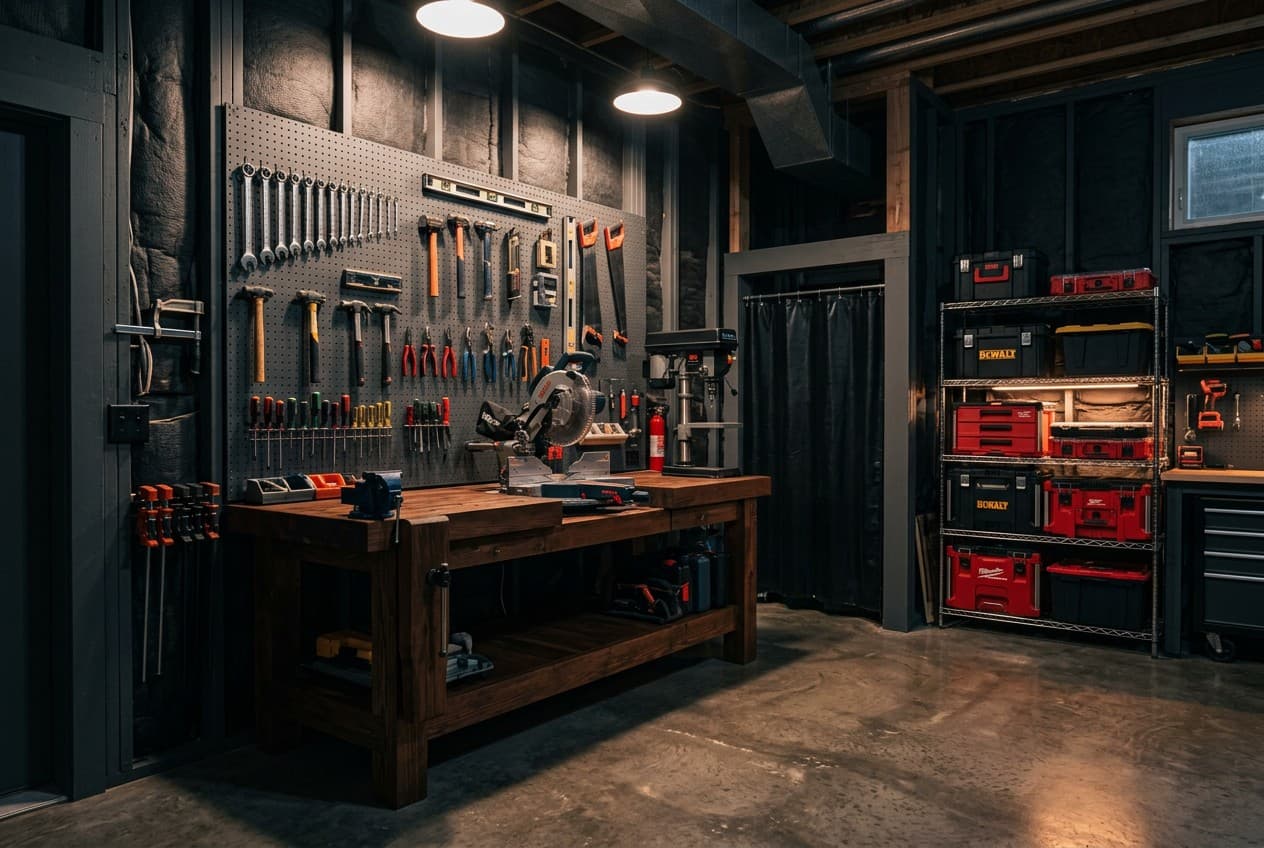
Why a Home Workshop Changes Everything
A home workshop is one of the most rewarding investments a homeowner can make. The ability to build, repair, and create on your own schedule — in your own space — pays dividends for decades. As a mechanical engineer with over 10 years of construction and fabrication experience, I've worked in professional shops and built personal workshops from scratch. The principles are the same whether you have a full two-car garage or a single parking space.
This guide covers everything in the right order: what to buy first, how to lay out your space, what electrical work you'll need, and how to build a functional shop for any budget.
In This Guide
Phase 1: Before You Buy a Single Tool
Define the Workshop's Primary Purpose
Different work types have different requirements. Choose your primary discipline before buying anything:
| Workshop Type | Core Tools | Space Requirement |
|---|---|---|
| General DIY / Maintenance | Drill, circular saw, jigsaw, basic hand tools | 80–120 sq ft |
| Woodworking | Table saw, miter saw, router, sanders | 200–400 sq ft |
| Metalworking | Angle grinder, welder, bench vise, drill press | 200–400 sq ft |
| Automotive | Floor jack, jack stands, specialty tools | 400–600 sq ft |
| Crafts / Light Making | Workbench, good lighting, organised storage | 80–150 sq ft |
Take Stock of Your Space
Before buying tools, measure your space and identify constraints:
- Floor dimensions and clearances around doors
- Ceiling height (critical for sheet goods handling and miter saw use)
- Electrical panel location and existing circuits
- Natural light and ventilation options
- Moisture situation (garages and sheds often have moisture issues)
Use the AI Garage Designer to upload a photo and get a space-specific workshop plan.
Phase 2: Workshop Layout Principles
Good workshop layout is the foundation of an enjoyable, safe workspace. The key principle: design for workflow, not storage aesthetics.
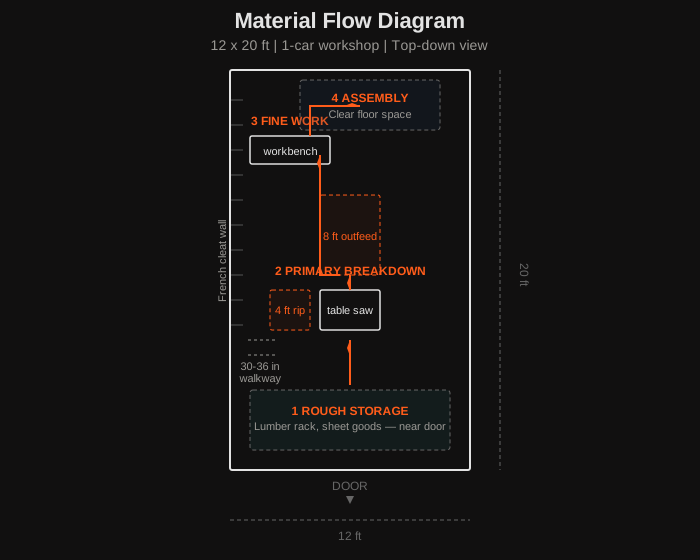
The Material Flow Model
Think about how material moves through your workshop:
- Rough storage (lumber rack, sheet goods rack) — near the door or access point
- Primary breakdown (table saw or track saw) — where material first gets cut to rough size
- Fine work (workbench, miter saw, router table) — where parts get finished
- Assembly area — clear floor space, typically the largest clear zone
Each step in the workflow should flow naturally to the next without cross-traffic.
Critical Space Planning Rules
- Table saw clearance: You need 8–10 feet behind and to the right of the blade for ripping sheet goods. This is the most commonly underestimated requirement.
- Miter saw clearance: 6–8 feet on each side for crosscutting long boards
- Walkway width: Minimum 30 inches between any two obstacles; 36 inches preferred
- Door clearance: Never block the workshop entrance — you'll be bringing in lumber and material regularly
The Workbench: Your Most Important Investment
A well-built workbench is the centre of any workshop. Key dimensions:
- Height: Working height should be at your wrist with arms hanging at your sides — typically 33–36 inches
- Depth: 24–28 inches; deeper than 30 inches makes the back hard to reach
- Length: As long as your space allows; 6–8 feet is a practical range
Don't buy a cheap bench. The workbench is where you fight wood and metal into submission — it needs to be rigid and heavy. Either build one from hardwood or buy a professional unit.
Top workbench options:
- Sjobergs Nordic Plus 1450 Workbench — premium hardwood, classic design
- Olympia Tools 330-Pound Capacity Workbench — solid budget option
DIY benchtop with plywood: If you're building your own workbench, Baltic Birch or Cabinet Grade 3/4-inch plywood makes an excellent benchtop surface. It's flat, stable, and significantly cheaper than solid hardwood. Use two layers of 3/4-inch glued and screwed together for a 1.5-inch thick top — rigid enough for most workshop use. Seal with several coats of polyurethane to protect against moisture and glue. Avoid standard construction-grade pine plywood; the surface is too soft and the faces too inconsistent for precision work.
Phase 3: The Essential Tool List By Budget
$500 Budget — The Beginner Foundation
This gets you everything you need for basic DIY, repair work, and simple projects:
Hand Tools (buy quality here — these last a lifetime):
- Claw hammer (Estwing)
- 25-foot tape measure (Stanley FatMax)
- Speed square
- Level — 24-inch
- Set of screwdrivers (Stanley or Klein)
- Pliers set — needle-nose, standard, adjustable
- Hand saw — Japanese pull saw or traditional crosscut
- Utility knife
- Chisels — 1/4", 1/2", 3/4", 1" set
- Mallet
Power Tools:
- Cordless drill/driver — this is your most-used tool; buy quality
- Circular saw — basic but capable of most cuts if you use a good fence
- Random orbital sander — 5-inch
Drills and Drivers Guide covers cordless drill and impact driver recommendations for this budget. Workshop Saws Guide covers circular saw options in detail.
Safety:
- Safety glasses
- Hearing protection (foam plugs minimum)
- Dust mask (N95)
$2,000 Budget — The Capable Workshop
Add to the $500 foundation:
Stationary / Benchtop Tools:
- Miter saw (10-inch compound) — the single most useful power tool for most woodworkers
- Jigsaw — for curves and interior cuts
- Router with starter bit set
- Shop vac — connects to sanders and routers for dust collection
Workbench setup:
- Solid workbench or heavy worktable
- Bench vise — 4-inch or larger
See our Workshop Saws Guide for how to choose the right miter saw size and type.
$5,000 Budget — The Serious Workshop
Add to the $2,000 setup:
Major Additions:
- Table saw — contractor or hybrid, 10-inch; this transforms what's possible in woodworking
- Drill press — 10-inch benchtop; for accurate vertical boring
- Band saw — 14-inch; for curves, resawing, and work a jigsaw can't do well
- Air compressor + nailer combo — framing nailer or brad nailer
- Dust collector — standalone unit connected to major machines
Workbench upgrades:
- Proper holdfast or quick-release vise
- Dog holes and workholding accessories
$10,000+ Budget — The Full Build
At this level you're adding:
- Jointer/planer combo or separate units — essential for working rough lumber
- Lathe (if turning interests you)
- 8-inch jointer
- Full dust collection system (cyclone separator + main collector)
- Spray finishing setup
For saw comparisons and buying advice, see our Workshop Saws Guide.
Phase 4: Workshop Electrical Requirements
This is where many homeowners get surprised. A productive workshop requires significantly more electrical capacity than a standard garage.
Minimum Requirements
Standard garage circuit (15A/120V): Powers basic hand tools, lighting, battery chargers. Not enough for a dedicated workshop.
Add at minimum:
- One dedicated 20A/120V circuit for the workbench area
- GFCI protection in all workshop circuits (code requirement near water; best practice everywhere)
- Outlet every 4–6 feet along the main working wall
Heavy Equipment Circuits
| Equipment | Circuit Required |
|---|---|
| 10" Table Saw | 20A/240V dedicated |
| Dust Collector (1.5–3HP) | 20A/120V or 20A/240V |
| Air Compressor | 20A/120V minimum; some large units require 240V |
| Welder (MIG) | 30–50A/240V depending on unit |
| Mini-split HVAC | 15–30A/240V depending on BTU |
What Each Tool Actually Needs
| Tool | Circuit | Voltage | Typical Amps | Dedicated Circuit? |
|---|---|---|---|---|
| Cordless drill / driver | Any shared | 120V | 2–4A (charger) | No |
| Circular saw | 15–20A | 120V | 12–15A | Shared OK |
| Miter saw (10–12") | 15–20A | 120V | 13–15A | Shared OK |
| Router | 15–20A | 120V | 12–15A | Shared OK |
| Table saw (contractor/hybrid) | 20A dedicated | 240V | 13–16A | Yes |
| Dust collector (1–2HP) | 20A | 120V or 240V | 10–15A | Yes |
| Air compressor (>2HP) | 20A dedicated | 240V | 15–20A | Yes |
| Welder (MIG) | 30–50A dedicated | 240V | 30–50A | Yes |
| Mini-split HVAC | 15–30A dedicated | 240V | 10–25A | Yes |
The most common electrical mistake in home workshops: putting the table saw and dust collector on the same 20A circuit. Both draw 13–15A — running together trips the breaker instantly. Each needs its own dedicated circuit.
Hire a licensed electrician for 240V circuit additions. This is not a DIY-safe area for most homeowners, and permitted work protects you at resale.
Phase 5: Dust Control — The Non-Negotiable
Sawdust is a health hazard. Fine wood dust (PM2.5 and below) is a known carcinogen and respiratory irritant. Dust control is not optional — it's a safety requirement.
The Three-Layer System
Layer 1 — At the Source: Connect a shop vac or small dust collector directly to each power tool as you use it. A 2.5-inch flex hose connects most sanders, routers, and miter saws directly to a shop vac.
Layer 2 — Central Collection: A dedicated dust collector (1–2HP) positioned near the table saw and bench tools. Cyclone separators like the Oneida Air Systems Dust Deputy dramatically extend filter life and collection efficiency.
Layer 3 — Ambient Air: An ambient air filtration unit hanging from the ceiling catches the fine particles that escape collection at source. The WEN 3-Speed Remote-Controlled Air Filtration System is popular and effective.
Sizing Your Dust Collector
The size of dust collector you need depends on your largest single machine — since you run one machine at a time using blast gates:
| Machine | Port Size | CFM Required |
|---|---|---|
| Table saw (cabinet) | 4" | 500–600 CFM |
| Table saw (contractor) | 4" | 350–400 CFM |
| Miter saw | 4" | 400–500 CFM |
| Planer (12–13") | 4" | 400–500 CFM |
| Jointer (6–8") | 4" | 350–450 CFM |
| Router table | 2.5–4" | 200–350 CFM |
| Bandsaw | 4" | 350–400 CFM |
| Random orbital sander | 1.5–2.5" | 150–200 CFM |
The rule: Your collector must exceed your highest single-machine CFM demand. A 1HP collector delivers ~650 CFM — sufficient for most contractor table saws and below. A cabinet table saw or planer demands a 1.5–2HP unit (800–1,200 CFM). Duct length and bends reduce effective CFM — every 90° elbow costs ~10 CFM equivalent.
Respiratory protection: Even with excellent dust collection, always wear a respirator when sanding, routing, or using a planer. An N95 is the minimum; a P100 half-face respirator is better for regular use.
Phase 6: Lighting and Ergonomics
Lighting
A workshop needs 100+ lumens per square foot at the work surface. For a 200 sq ft workshop:
- General ceiling lighting: 20,000+ total lumens
- Task lighting over workbench: Additional 5,000–10,000 lumens
Linkable LED shop lights are the standard solution. See the full lighting section in our Garage Makeover guide for specific product recommendations.
Add an under-cabinet light strip over the workbench. This eliminates the shadow cast by your own head and hands — a game-changer for precise work.
Anti-Fatigue Mats
Standing on concrete for hours is brutally hard on joints. Anti-fatigue mats over epoxy flooring at the workbench and major machines are a worthwhile quality-of-life upgrade.
Imprint CumulusPRO Anti-Fatigue Mat — designed specifically for shop environments.
Phase 7: Tool Storage and Organisation
Good tool storage makes you more productive because you can find what you need instantly.
French Cleats — The Workshop Standard
A french cleat system is the most flexible, lowest-cost tool storage solution available. Cut 3/4" plywood into strips at 45°, mount them horizontally on the wall, and build custom holders for every tool you own. The angle locks holders in place but allows instant repositioning.
Start here: Cover one wall in french cleats. Add holders as you build them or buy them.
Tool Chest + Rolling Cabinet
For a comprehensive hand tool collection, a rolling tool chest is hard to beat for density and organisation. Key brands by quality tier:
- Budget: Husky 52-inch rolling cabinet (Home Depot) — good value
- Mid-range: Craftsman 56-inch rolling tool chest — quality construction
- Premium: Snap-on or Matco — professional grade, significant investment
Power Tool Storage
Wall-mounted brackets or dedicated shelves for heavy power tools (table saw, band saw) prevent accidents and keep the floor clear. Never lean power tools against walls.
Workshop Safety Checklist
Before using your workshop, verify:
- Fire extinguisher mounted near the exit (ABC rated, minimum 2.5 lbs)
- First aid kit accessible and stocked
- Eye and ear protection at every major machine
- Dust mask or respirator within arm's reach of the bench
- All extension cords are proper gauge (no undersized cords for power tools)
- Table saw blade guard in place when appropriate
- Push sticks available near the table saw
- No loose clothing, jewellery, or long hair uncontained
- Clear path to the door
- Adequate ventilation (exhaust fan running when working with finishes or solvents)
Ready to Plan Your Workshop?
Upload a photo of your garage or shed and get a personalised workshop setup plan — the AI Garage Designer analyses your space and returns a prioritised build list with specific product recommendations for your budget.
Related guides: