
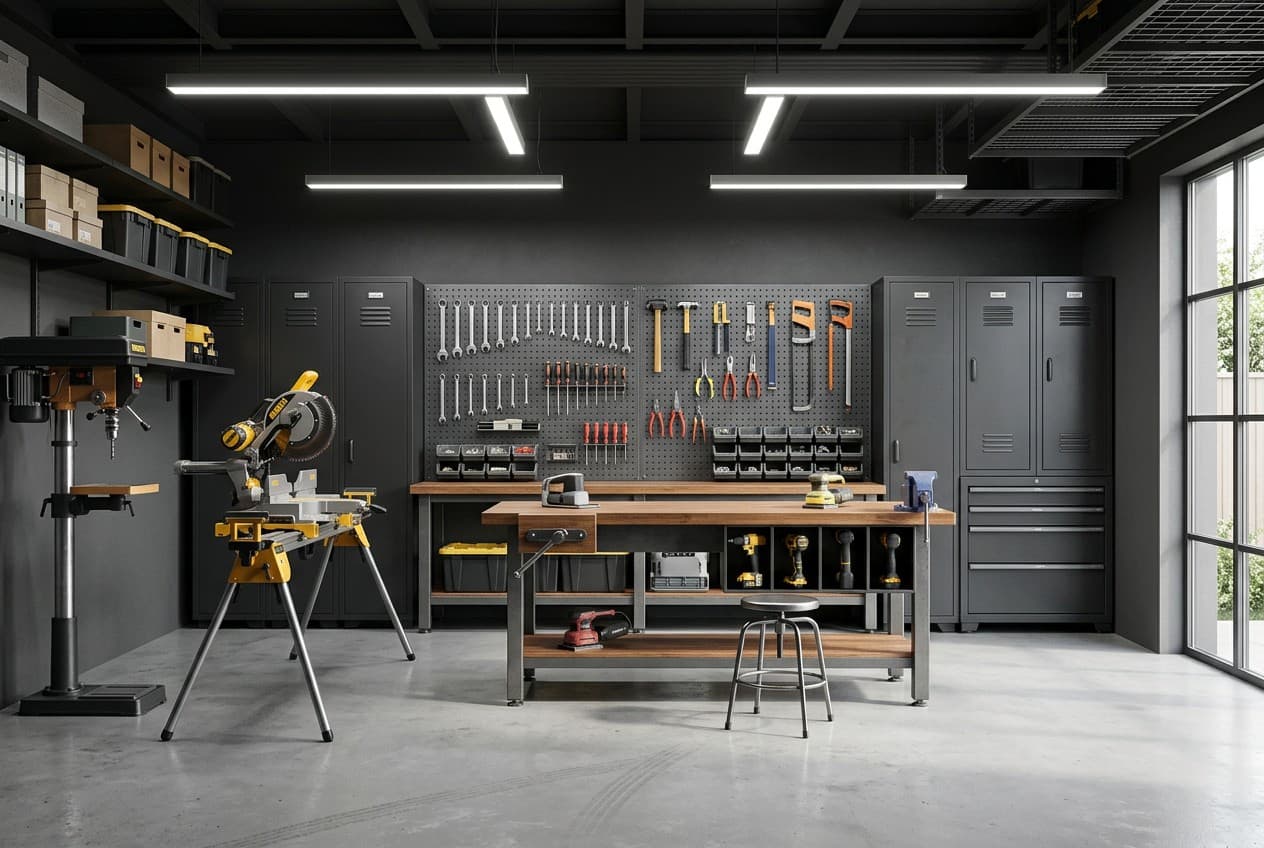
The Most Underestimated Workshop Upgrade
Workshop lighting is almost always the last thing people think about and the first thing they notice once it's fixed. The difference between a 60-watt incandescent ceiling bulb and four 5,000-lumen LED shop lights is not subtle. It changes what you can see, what you can safely do, and how long you can work without eye strain.
Poor lighting causes three real workshop problems: measurement errors (misread tape measures, misaligned cuts), safety hazards (shadows that hide blade position, poor depth perception on saw work), and fatigue (eyes working harder, concentration dropping faster).
This guide covers what you actually need — lumen targets, fixture types, placement rules, and the products that deliver.
Lumen Requirements by Workshop Size
The standard residential lighting recommendation of 20–30 lumens per square foot does not apply to workshops. Detailed work requires 50–80 lumens per square foot at the work surface.
These are lumen-per-sq-ft targets at the work surface, not at the ceiling fixture.
The Three Lighting Layers
Every functional workshop uses three distinct layers:
- General (ambient) lighting — overhead fixtures providing even base illumination across the entire shop. LED shop lights in rows. This is the foundation.
- Task lighting — directed light at specific work surfaces: above the workbench, over the miter saw station, under upper cabinets. Supplementary and targeted.
- Accent / safety lighting — under overhead cabinets, at floor level near machines, or anywhere a shadow creates a hazard. Often the most overlooked layer.
Option Comparison
| Fixture Type | Cost EachRecommended | Output | Lifespan | Linkable | Best For |
|---|---|---|---|---|---|
| Fluorescent 4 ft shop light (T8) | $20–$50 | 3,200–4,400 lm | 15,000–30,000 hrs | Sometimes | Budget setups, existing fluorescent wiring |
| LED shop light (4 ft, linkable) | $30–$80 | 4,000–6,000 lm | 50,000+ hrs | Yes (most models) | New installs — best value and output |
| LED wraparound / flat panel | $40–$90 | 3,500–5,500 lm | 50,000+ hrs | Some models | Finished spaces, low-profile ceiling |
| LED high bay | $60–$150 | 10,000–20,000+ lm | 50,000+ hrs | No | High-ceiling garages (14 ft+), large shops |
| Track lighting | $80–$250 | Variable | 50,000+ hrs | N/A | Adjustable task lighting, finished workshops |
| Under-cabinet LED strip | $15–$60 | 500–1,200 lm per metre | 30,000–50,000 hrs | Yes | Workbench task lighting only |
Colour Temperature
Colour temperature (measured in Kelvin) determines how "warm" or "cool" the light appears and significantly affects workshop usability.
- 2,700–3,000K (warm white): the tone of incandescent bulbs. Comfortable for living spaces. Poor for workshops — colours shift, fine details harder to see.
- 4,000K (cool white): good general workshop lighting. Colours reasonably accurate. Fine for most shops.
- 5,000–6,500K (daylight): the correct choice for a workshop. Colours are accurate, contrast is high, fine details are visible. Slightly harsh to some eyes but significantly safer and more accurate for detailed work.
Recommendation: 5,000K for the main shop area. 4,000K is acceptable if you find pure daylight tones too clinical.
Placement Rules
Row spacing: for even illumination, space rows no further apart than the ceiling height. In an 8-ft ceiling garage, fixture rows should be no more than 8 ft apart.
Row count: for a 12-ft wide garage with an 8-ft ceiling, two rows (one at 4 ft from each wall) provides good even coverage. For a 20-ft wide garage, three rows.
Workbench task lighting: mount a separate fixture 18–24 inches above the bench surface, not at ceiling height. A ceiling-mounted general light 8 ft above does not provide adequate task illumination at the bench.
Saw table lighting: ensure no overhead fixture is positioned directly above the blade. Backlighting (fixture slightly behind the blade position from your working position) reduces blade glare. Sidelight (from the left or right) shows cut line shadow clearly.
Cost Comparison
Workshop Lighting — Fixture Cost for a 1-Car Garage (3–4 Fixtures)
Frequently Asked Questions
Do I need to add circuits for more lights?
Standard lighting circuits in residential garages are 15A. Each LED shop light draws about 0.4–0.6A. Four shop lights draw 1.6–2.4A — well within a 15A circuit. Adding 6–8 fixtures is still typically within a single 15A lighting circuit. Only add a circuit if you're running tools and lights on the same breaker and are approaching 80% of breaker capacity.
Are LED shop lights safe near sawdust?
Most LED shop lights are rated IP20 or similar (dust-protected) — adequate for normal workshop dust accumulation. Clean lenses annually with a damp cloth. In very dusty environments (cnc routing, heavy sanding), consider IP65-rated fixtures.
Linkable vs non-linkable fixtures?
Linkable fixtures allow you to daisy-chain multiple lights from a single power connection, reducing the number of electrical connections to the ceiling and simplifying the install. For rows of fixtures above a workbench, linkable is significantly easier. For independently positioned general lights, linkable is irrelevant.
Related Guides
- Small Garage Workshop Layout Ideas — where the fixtures go within your layout
- Workshop Setup Hub: Complete Guide — the full workshop planning resource
- Workshop Wall Storage Guide — what to mount on the walls once the lights are up
Use the AI Garage Designer to plan your workshop setup — including lighting placement, zone layout, and fixture recommendations for your specific garage dimensions.
If your workshop doubles as a man cave or social space, the man cave lighting ideas guide covers how to layer ambient, accent, and bar lighting in the same space — the principles complement workshop task lighting without conflict.