
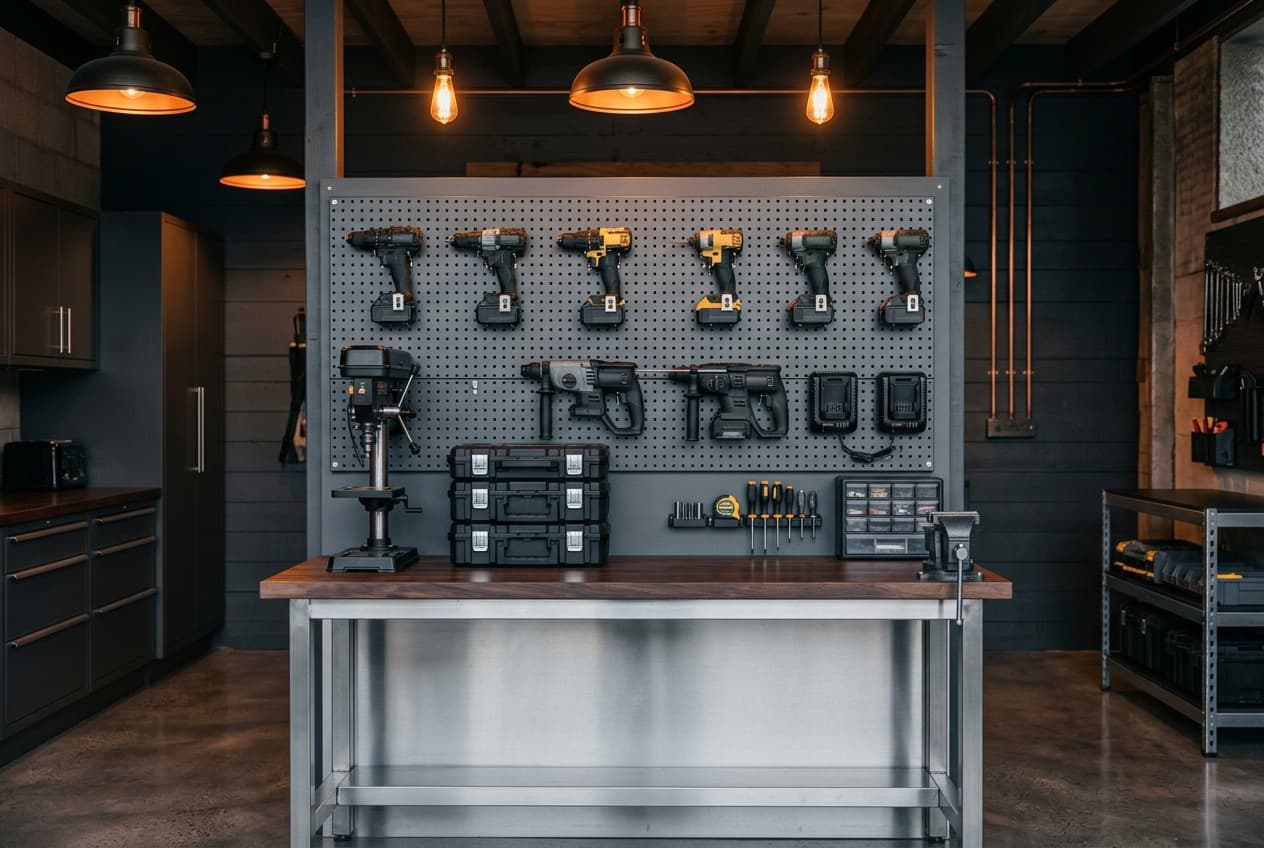
You Have One Drill. Now You're Not Sure That's Enough.
Most workshop builders hit the same wall: a cordless drill that came with the house or was bought years ago, and a growing list of jobs it handles badly. Long screws cam out. Holes in masonry go nowhere. You've seen someone use an impact driver and it looked effortless. Now you're wondering whether you need that, a hammer drill, or both — and whether the drill press you keep seeing recommended is something you actually need or just want.
The good news is that the decision tree here is simpler than it looks. Each tool in this category solves a specific problem. Understanding what those problems are makes the buying sequence obvious. Most home workshop builders need exactly two tools from this category — and they should buy them together.
How the Main Drill and Driver Tools Compare
| ToolRecommended | Primary Use | Chuck Type | Best Material | Price Range | Priority |
|---|---|---|---|---|---|
| Drill / Driver | Drilling holes and driving screws with clutch control | 3-jaw keyless | Wood, plastic, light metal | $80–$200 | Essential |
| Impact Driver | Driving long fasteners and screws at speed | 1/4" hex collet | Wood, framing, structural screws | $80–$180 | Recommended |
| Hammer Drill | Drilling into concrete, brick, and masonry | 3-jaw keyless | Masonry, concrete, block | $120–$250 | Optional |
| SDS Rotary Hammer | Heavy-duty concrete drilling and chiseling | SDS-plus bayonet | Dense concrete, stone, rebar | $200–$500 | Advanced |
| Drill Press | Precision vertical holes in wood and metal | 3-jaw keyed | Wood, metal, plastics | $150–$600 | Optional |
Drill and Driver Tools — Priority Guide
Workshop Drills and Drivers — Tool Priority Guide
| Tool / Item | Use | Est. Cost | Priority |
|---|---|---|---|
| Drill / Driver (18V or 20V) | Drilling holes and driving screws in wood, metal, and plastic. The single most-used tool in any workshop or home. | $80–$200 | Essential |
| Impact Driver | Driving long screws, structural fasteners, deck screws, and lag bolts without wrist strain or cam-out | $80–$180 | Recommended |
| Hammer Drill | Drilling into concrete, brick, block, and masonry for anchors and hardware installation | $120–$250 | Optional |
| Drill Press | Precise vertical holes in wood and metal where freehand drilling risks angled or misaligned holes | $150–$600 | Optional |
| SDS Rotary Hammer | High-volume drilling into dense concrete, chiseling, and breaking out tile or masonry | $200–$500 | Optional |
When to Upgrade Your Drill
These are the use-case triggers that tell you which tool to add next — not marketing categories.
The Combo Kit Case: Buy Drill and Impact Driver Together
The single best value decision in the drill and driver category is buying a drill and impact driver as a matched combo kit from the same manufacturer. Combo kits from DeWalt, Milwaukee, and Makita typically include both tools, two batteries, and a charger for $180–$260 — compared to $140–$180 per tool if bought separately. Since both tools share the same battery platform, you are building a battery ecosystem from day one rather than accumulating incompatible packs.
The practical case for owning both is just as strong as the financial one. In a typical home workshop session you switch between these tools constantly: drill a pilot hole with the drill/driver, drive the screw home with the impact driver, back to the drill for the next clearance hole. Doing this with a single tool means swapping bits every time, which adds up to real frustration across a project. When you own both, each tool stays loaded — drill with a twist bit, impact driver with a driver bit — and you simply reach for whichever one the next operation requires. This is the workflow upgrade that makes your workshop feel professional.
Frequently Asked Questions
Do I need both a drill and an impact driver?
Yes, if you do any volume of fastening work. The drill/driver is for drilling holes and driving screws where clutch control matters — overdriving into soft wood, setting screws to a specific depth, or driving small fasteners that would strip under impact. The impact driver is for everything that requires sustained driving torque: 3-inch structural screws, lag bolts, deck screws, or any situation where you have driven 50+ fasteners in a session and your wrist is the limiting factor. The tools are complementary, not redundant. Buy them as a combo kit to save $60–$80 over buying separately.
What is a hammer drill used for?
A hammer drill combines standard rotation with a forward-percussion action — two ribbed discs in the drive mechanism create a rapid hammering motion that drives the bit into masonry as it rotates. This is the correct tool for drilling holes in concrete blocks, brick, and poured concrete for anchors, hardware, and wall mounts. A standard drill/driver will barely scratch dense concrete regardless of bit quality. Most hammer drills are also standard drills with a mode switch, so you get three tools in one: standard drill, clutched driver, and hammer drill. The upgrade is worthwhile once you have any masonry work planned — hanging shelving on a brick wall, mounting hardware to a concrete floor, or installing anchors in a block foundation.
Brushed vs brushless motors — does it matter?
Yes, meaningfully so. Brushed motors use carbon brushes that make physical contact with the commutator to deliver power. They wear over time, generate more heat, and waste some energy as friction. Brushless motors use electronic sensors to control power delivery — no contact, no wear from friction, more consistent torque, longer runtime per charge, and a significantly longer tool lifespan. In practical terms: a brushless drill/driver will run 30–50% longer on the same battery and will outlast a brushed equivalent by years under regular workshop use. The price premium for brushless is $20–$50 in most combo kits. It is worth paying. If you are buying a cordless drill today, buy brushless.
What to Do Next
Now that you know which drill and driver tools to buy and in what order, the next step is mapping them into your actual workspace — where your charging station goes, how your tool storage is laid out, and how the rest of your workshop build sequences around your first two power tools.
For the full workshop tool build sequence by budget and phase, the workshop setup guide covers every category in the same structured format.
Workshop Setup: Complete Guide →
Drills and saws are the two tool categories most workshops build around first — the workshop saws guide covers which saw to buy next and how the two categories work together across common projects. Once your power tools are sorted, the best workbench for a small garage guide helps you choose a bench that supports your drill press and assembly work without eating up floor space.