
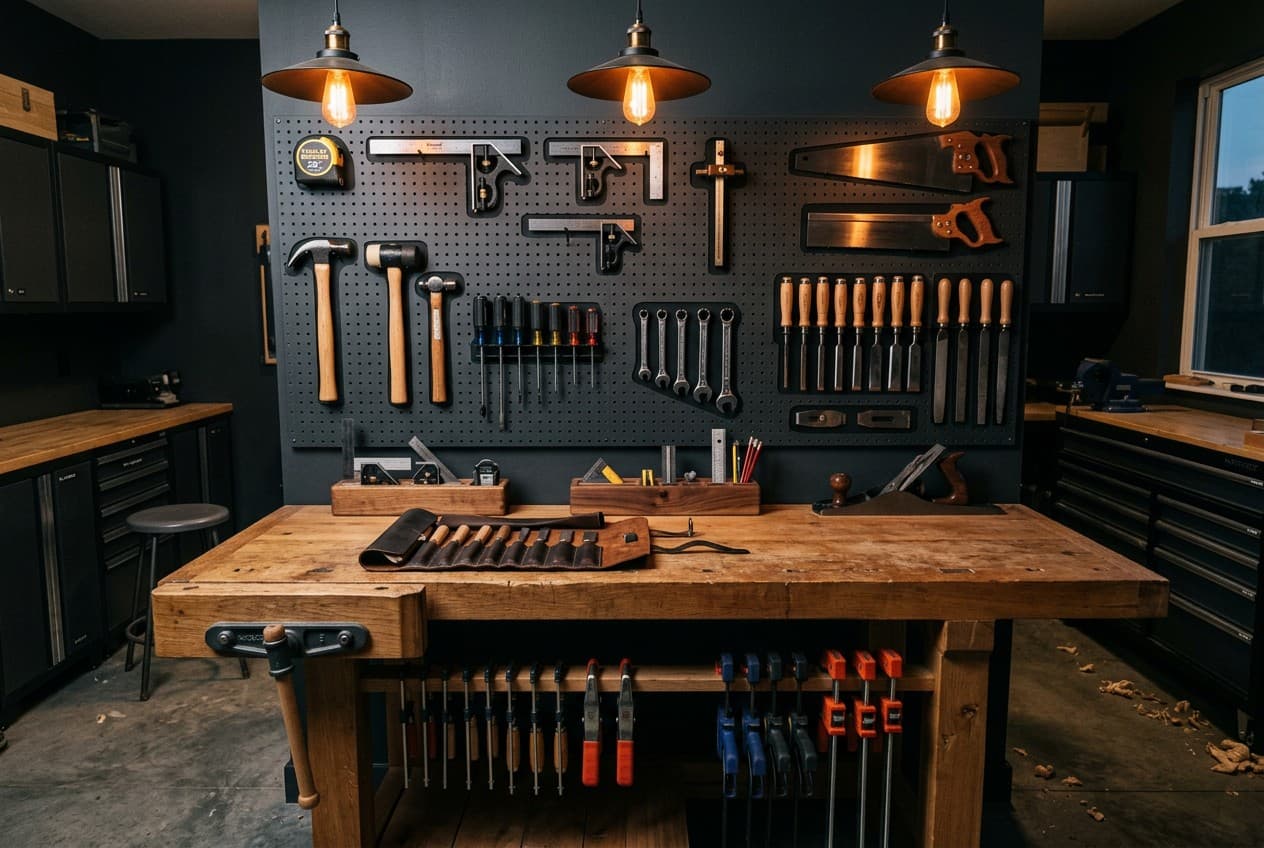
Buying hand tools without a plan leads to a cluttered drawer of things you rarely use and a missing tool on the day you actually need it. Most workshops accumulate in the wrong order — impulsive purchases made at the hardware store, duplicated categories, gaps in the basics. This guide organizes the hand tools a workshop needs across four categories, with priority labels so you know what to buy first, what to add as your work expands, and what you can safely defer.
The four categories are: measuring and layout, striking and fastening, cutting and shaping, and clamping and holding. Work through them in that order.
Measuring & Layout Tools
No other category determines project success as directly as measuring and layout. A measurement error compounds through every downstream cut, joint, and assembly. Buy quality here before anything else.
Measuring & Layout Tools — Priority Guide
| Tool / Item | Use | Est. Cost | Priority |
|---|---|---|---|
| Tape Measure (25 ft) | All layout, cutting, and assembly measurement | $15–$35 | Essential |
| Combination Square (12 in) | Checking squareness, marking consistent depths, 45° layout | $20–$45 | Essential |
| Marking Gauge | Scribing parallel lines along grain for joinery, tenons, and rabbets | $15–$40 | Recommended |
| Level (24 in) | Checking flat and plumb on assemblies, cabinets, and wall storage | $20–$40 | Recommended |
| Chalk Line | Marking long straight reference lines across sheet goods or floor surfaces | $10–$20 | Optional |
The tape measure and combination square are the two tools you reach for on every project. A cheap tape measure that reads inconsistently corrupts every cut it informs — buy once and buy right. The combination square earns its place by doing what a speed square cannot: depth gauging, scribing consistent lines, and checking squareness on joinery.
Striking & Fastening Tools
Striking & Fastening Tools — Priority Guide
| Tool / Item | Use | Est. Cost | Priority |
|---|---|---|---|
| Claw Hammer (16 oz) | Driving and pulling nails, framing, general assembly | $20–$35 | Essential |
| Screwdrivers (set) | Manual fastening, hardware installation, delicate assembly work | $10–$30 | Essential |
| Rubber Mallet | Assembly work, driving chisels, seating joints without surface damage | $12–$25 | Recommended |
| Pliers (set) | Gripping, bending, holding — needle-nose, slip-joint, and adjustable | $20–$50 | Recommended |
| Adjustable Wrench | Bolts, nuts, and plumbing fittings across a range of sizes | $15–$35 | Recommended |
The 16 oz claw hammer is the most-used striking tool in any workshop. Do not buy cheap — a hammer with a loose head is a safety hazard, and a quality forged-steel hammer lasts decades. A basic screwdriver set handles what a power driver cannot: delicate hardware, over-torque-sensitive fasteners, and anything in a space too tight for a drill. Add a rubber mallet once you start cutting joinery — a hammer mars wood surfaces that a mallet won't.
Cutting & Shaping Tools
Cutting & Shaping Tools — Priority Guide
| Tool / Item | Use | Est. Cost | Priority |
|---|---|---|---|
| Utility Knife | Scoring before cutting, breaking down sheet material, scribing trim | $10–$25 | Essential |
| Hand Saw | Crosscutting lumber, rough cuts, work away from power tools | $20–$40 | Essential |
| Wood Chisels (set, 4 piece) | Cleaning mortises, paring joinery, chopping waste, trimming hinge recesses | $25–$60 | Recommended |
| Block Plane | Trimming end grain, fitting doors, chamfering edges, final surface prep | $30–$70 | Recommended |
| Files and Rasps | Shaping wood and metal, smoothing curves, deburring cut metal edges | $15–$40 | Optional |
The utility knife is used constantly — scoring wood before a cut prevents tearout, and a sharp blade at the right angle is more precise than any pencil line. Chisels are transformative for joinery quality, but only when sharp: budget for a sharpening stone when you buy the set. A dull chisel tears fibres and requires dangerous levels of force. The block plane is the hand tool most beginners defer too long — nothing matches it for trimming end grain and fitting tight-clearance assemblies.
Clamping & Holding Tools
Clamping & Holding Tools — Priority Guide
| Tool / Item | Use | Est. Cost | Priority |
|---|---|---|---|
| F-Clamps (set of 4) | Glue-ups, holding assemblies during fastening, securing work to bench | $25–$50 for 4 | Essential |
| Quick-Grip Clamps (set of 2) | One-handed clamping for panel work and positioning before fastening | $20–$40 for 2 | Recommended |
| Workbench Vise | Holding lumber securely for hand planing, sawing, and chiselling | $60–$150 | Recommended |
| Corner Clamps | Holding frame and box assemblies square during glue-up | $15–$35 for 2 | Optional |
You will never own enough clamps — this is a reliable fact of workshop life. Start with four F-clamps in a medium throat depth (6 to 8 inch). They handle most glue-ups, panel holding, and workholding tasks at the bench. Quick-grip clamps earn their place when you need to position something with one hand and fasten with the other. A bench vise is the single upgrade that most transforms hand tool work: it holds lumber without slipping and frees both hands for precise work.
Building the Kit in Layers
Build the hand tool kit in layers rather than buying across all categories at once. The measuring and striking tools come first because they are used on every project from day one — without a square and a hammer, no other work is possible. Add cutting tools once you have a workbench or a solid work surface to use them on; chisels and hand saws need secure workholding to be used safely and accurately.
Clamping tools should come last in the initial build, but expand fastest once projects start demanding them. A glue-up without enough clamps either fails or requires improvised pressure that produces poor joints. As soon as your first furniture or assembly project is in progress, buy more clamps than you think you need — the standard advice is to double your estimate. Corner clamps and specialty holding tools can wait until a specific project calls for them; buying them speculatively usually means they sit unused.
The tools in the essential tier across all four categories represent a complete working kit for approximately $150 to $200. The full recommended tier brings the kit to roughly $350 to $450. Buy quality on the hammer, the tape measure, and the chisels — these tools receive constant use and the difference in quality is felt immediately. On optional items, mid-range brands are usually sufficient since they see less frequent use.
FAQ
What hand tools do I need first?
Start with the essential tier across measuring and striking: a tape measure, combination square, claw hammer, and screwdriver set. Add a utility knife and hand saw and you have everything needed to complete most basic projects. These six tools represent the foundation everything else builds on.
Can I use cheap hand tools?
For optional and some recommended tools, mid-range quality is usually fine. For the tools you use every day — the tape measure, hammer, and chisels — cheap versions actively impede your work. A tape measure that binds or reads inconsistently corrupts measurements. A chisel that won't hold an edge wastes time at the sharpening stone after every few cuts. Spend the extra $10 to $20 on the daily drivers.
Do I need a hand saw if I have a circular saw?
Yes. A circular saw needs setup space, a power source, and a clear work area. A hand saw starts instantly, works in confined spaces, makes short cuts faster than setting up a circular saw for them, and handles cuts too short or awkward for a powered blade safely. They are complementary tools, not substitutes. The hand saw also develops saw control that transfers directly to better powered-saw technique.
What to Do Next
Ready to plan where all of these tools will live?
Design your workshop layout with the Garage Designer — map out your bench, storage, and tool positions before you start buying storage systems.
For a broader view of workshop setup — power tools, layout by budget, and build phase planning — see the Workshop Setup guide.
For metal and surface prep work that hand tools alone can't handle, the angle grinder guide shows how power grinding complements chisels, files, and hand planes on the same projects. Once you've built your hand tool kit, the guide to organising a tool chest will help you set up a drawer system so every tool is exactly where you expect it.