
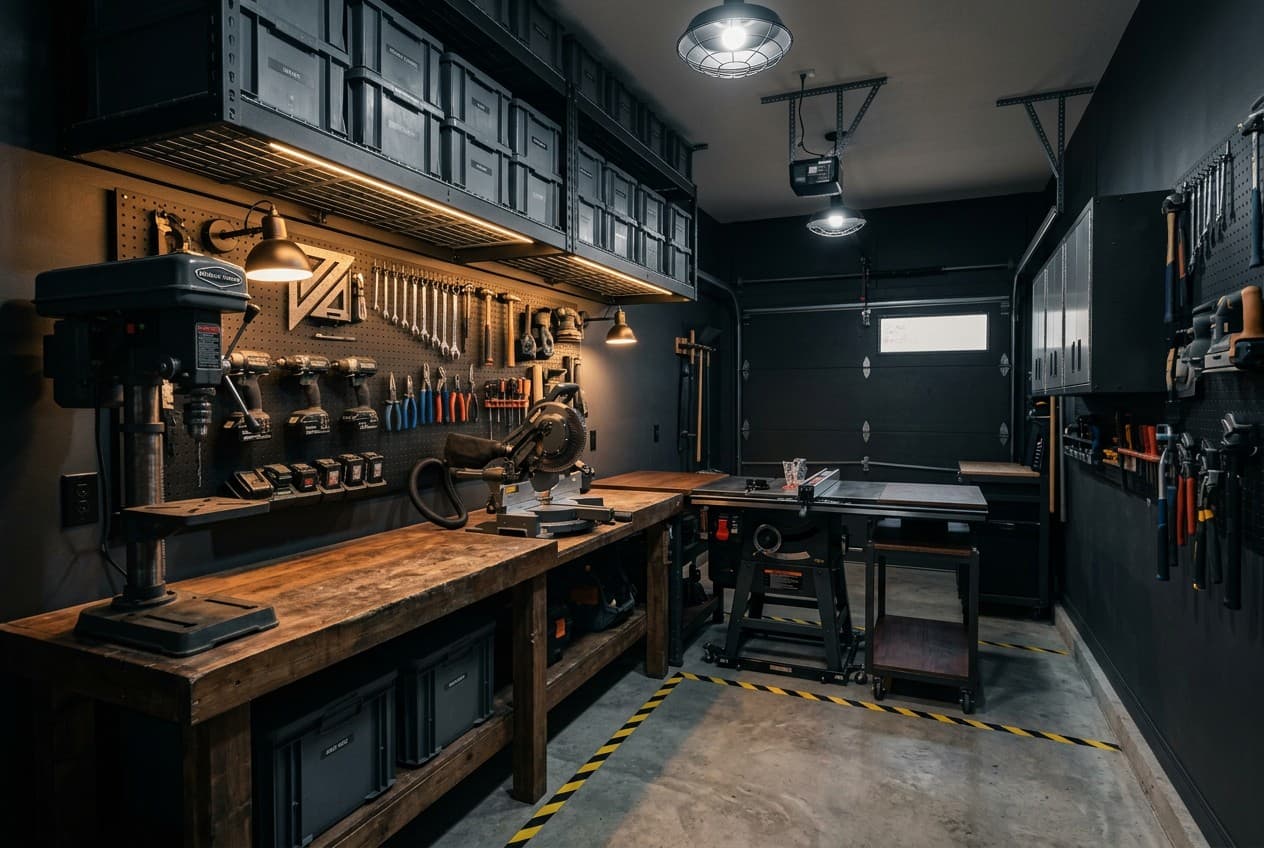
The Challenge of the Small Garage Workshop
Every garage workshop starts the same way: a vision of a clean, organised, functional shop, and a reality that involves a saw in one corner, a workbench blocking the car, and tools living on the floor.
Small garages — 1-car (150–240 sq ft) and compact 2-car (300–440 sq ft) — are absolutely workable as workshops. But the layout decisions are unforgiving. A table saw in the wrong position kills your outfeed clearance. A workbench along the wrong wall blocks your wall storage. The car ends up permanently outside because you never planned the return path.
This guide gives you three proven layout configurations and the tool clearance dimensions that prevent the most common mistakes.
The Three Workshop Layout Zones
Every functional workshop needs these three zones, regardless of size:
- Assembly/primary work zone — the workbench, the main work surface, and access to the power outlet you'll use most. This is the center of gravity.
- Stationary tool zone — table saw, band saw, drill press, scroll saw. These need clearance on all sides for outfeed and safe movement.
- Storage zone — wall-mounted tool storage, lumber, hardware, and consumables. Off the floor entirely.
The single biggest mistake in workshop layout: buying tools first, placing them wherever they'll fit, then trying to make it work. The zones come first.
Layout 1: Minimal 1-Car Shop (12×20 ft)
This layout gives you a fully functional workshop in a single-car garage — with the car still inside. It requires discipline: only essential tools, all storage vertical, and a layout that uses every inch.
1-Car Minimal Workshop (12×20 ft)
Total: 240 sq ftKey trade-offs in this layout:
- Table saw, if included, must be a contractor saw on a folding stand — stored against the wall when not in use
- No dedicated lumber storage inside — lumber goes in the rafters or outside
- Works best for small woodworking, hand tool work, and general repairs
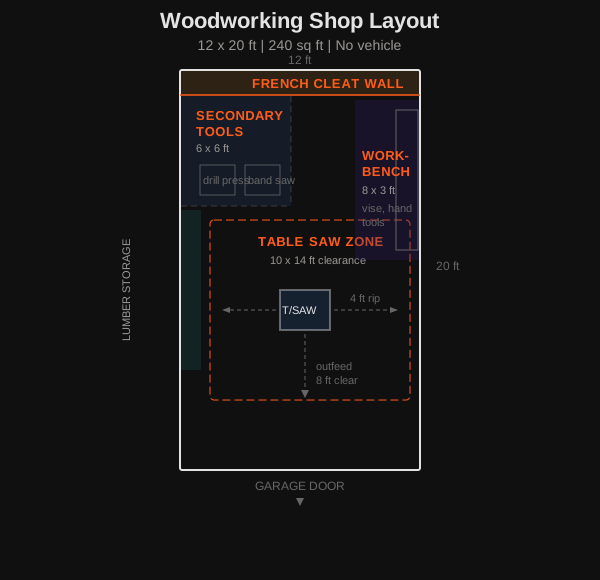
Layout 2: Dedicated Woodworking Shop (1-Car, No Car)
If the car is out and the entire 240 sq ft is yours, you can build a serious small shop. This layout is optimized for woodworking — it puts the table saw in the center (where it belongs) and builds everything else around it.
Woodworking Shop — 1-Car (No Car)
Total: 240 sq ftThe table saw clearance rule: you need outfeed clearance equal to the length of your longest workpiece. For cutting 8-ft sheet goods, you need 8 ft behind the blade. In a 12×20 garage, place the saw on the long axis (20 ft direction) — this gives you the maximum possible outfeed run.
Layout 3: Full 2-Car Shop (20×22 ft)
A 2-car garage gives you enough room for a serious multi-function shop. This layout separates the noisy/dusty power tool area from the assembly/hand tool area — a quality-of-life upgrade that dedicated woodworkers quickly learn to value.
Full 2-Car Shop (20×22 ft)
Total: 440 sq ftThese are the measurements that determine whether your tool layout actually works.
What Not to Do: Common Layout Mistakes
1. Workbench on the back wall in a 1-car garage This puts the bench in the deepest part of the garage, with no room to work on long boards. Workbench should be on a side wall, with the long axis running parallel to the garage.
2. Table saw against a wall The table saw needs outfeed clearance behind it. Against a wall means you can only cut stock as long as the saw-to-wall distance. Centre-of-room placement is the standard for a reason.
3. No dedicated storage for the car situation If you're sharing the garage with a vehicle, you need a storage plan that makes it easy to get the car in and out without moving tools. Bench height matters here — a workbench at 34 in doesn't block line-of-sight for pulling in.
4. Buying lumber before having storage for it Lumber on the floor becomes an obstacle. Plan a wall-mounted horizontal rack or vertical slotted lumber cart before your first board arrives.
Related Guides
- Best Workbench for a Small Garage Workshop — what to buy based on your workshop type
- Workshop Setup Hub: Complete Guide — the full workshop planning resource
- Workshop Saws Guide — what table saw (and other saws) fit which shop size
- Workshop Drills and Drivers Guide
Use the AI Garage Designer to plan your exact workshop layout — upload a photo, enter your dimensions, and get zone and tool placement recommendations for your specific garage.
If you're planning a compact workspace in a shed rather than a garage, the small shed office layout guide applies the same zone-first planning principles to the tighter footprints and different structural constraints of a typical garden shed.