
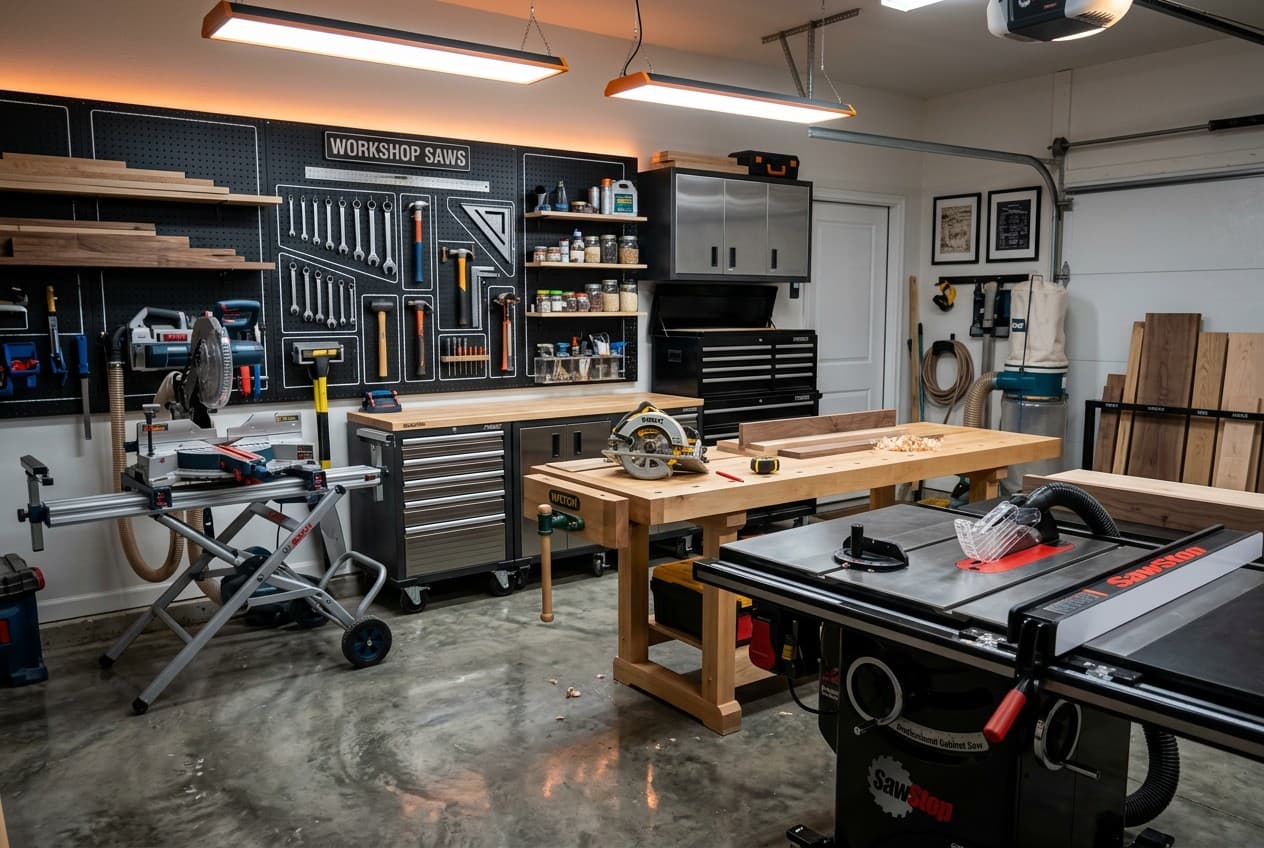
The Saw Decision That Trips Up Every New Workshop Builder
You're putting together your first real workshop and you know you need saws — but every article seems to assume you're either a beginner who needs the basics explained or a seasoned woodworker debating cabinet saws. You're neither. You're someone who wants to build things, fix things, and make good buying decisions that will actually hold up.
The honest answer to "which saws do I need?" is this: you don't need them all, and the sequence in which you buy them matters as much as which ones you eventually own. A circular saw and a miter saw together handle roughly 80% of the cuts that come up in a home workshop. Everything after that is a targeted upgrade for a specific limitation you've actually encountered.
This guide will show you which saws matter, in what order, and why the most common first-timer mistake — buying a table saw before a circular saw — creates more problems than it solves.
Workshop Saws — Priority Guide
Workshop Saws — Tool Priority Guide
| Tool / Item | Use | Est. Cost | Priority |
|---|---|---|---|
| Circular Saw | Portable straight cuts, breaking down sheet goods, framing and general cutting | $60–$200 | Essential |
| Miter Saw (compound) | Accurate crosscuts, angle cuts, trim and molding work | $150–$500 | Recommended |
| Jigsaw | Curved cuts, interior cutouts, irregular shapes in thin material | $50–$150 | Recommended |
| Table Saw | Precise rip cuts, repeatability, dado and groove cuts | $350–$1,500+ | Optional |
| Band Saw | Curves in thick stock, resawing lumber, gentle radius cuts | $300–$800 | Optional |
| Reciprocating Saw | Demolition, renovation cutting, rough work in tight spaces | $80–$200 | Optional |
How the Main Saws Compare
| Saw TypeRecommended | Best For | Accuracy | Portability | Price Range |
|---|---|---|---|---|
| Circular Saw | Sheet goods, framing, portable straight cuts | Medium (high with guide) | High | $60–$200 |
| Miter Saw | Crosscuts, angle cuts, trim and molding | High | Medium | $150–$500 |
| Table Saw | Ripping boards, repeatable precision, dado cuts | Very High | Low | $350–$1,500+ |
| Jigsaw | Curves, cutouts, irregular shapes | Medium | High | $50–$150 |
| Band Saw | Curves in thick stock, resawing lumber | Medium–High | Low | $300–$800 |
Which Saws to Buy First — and Why
The circular saw is the correct first saw for almost every workshop builder. It is portable, versatile, and with a straight-edge clamp it can make cuts that rival a table saw in accuracy. A 7-1/4-inch circular saw with a good 40-tooth blade will break down full 4x8 sheet goods, rip boards along their length, and cross-cut dimensional lumber. It works on site, in your driveway, and in tight spaces where a table saw cannot follow you. Entry-level models start under $100; a capable mid-range saw costs $150–$180.
The miter saw earns the second slot because it fills in the one gap a circular saw has: fast, repeatable, accurate crosscuts. Once you own a compound miter saw you will use it constantly — trim work, cutting lumber to length, picture frames, shelving, stair treads. A 10-inch dual-bevel compound miter saw handles 95% of workshop crosscut scenarios and takes up far less floor space than a table saw. The circular saw and miter saw combination is genuinely capable of handling the majority of cuts in a home workshop, at a combined cost of $300–$600, with no permanent floor space commitment.
The table saw earns its place eventually — particularly if you do serious woodworking and need repeatable rip cuts with precision fence control. But a table saw bought before you've actually hit the limits of a circular saw is money and floor space spent prematurely. Buy it when the circular saw is genuinely slowing you down. That moment tells you you're ready for it.
Miter Saw — The Workshop Anchor
Miter Saw — Why It's the Workshop Anchor
- ✓Fast, repeatable crosscuts with no setup beyond setting the fence stop
- ✓Built-in detents at common angles (22.5°, 45°, 90°) for instant accurate cuts
- ✓Controlled, stable cutting motion — blade comes down onto clamped material
- ✓Handles trim carpentry, shelving, stair work, and framing cuts equally well
- ✓Compact footprint compared to a table saw — mounts to a folding stand or workbench
- ✗Not portable in the way a circular saw is — needs a stable mounting surface
- ✗Limited by the blade's diameter: a 10-inch saw cannot crosscut very wide boards flat
- ✗Cannot rip boards lengthwise — that job belongs to the circular saw or table saw
- ✗Overkill if you only occasionally need a clean crosscut
Frequently Asked Questions
Do I need a table saw?
Most home workshop builders do not need a table saw in the first year. A circular saw with a straight-edge guide replicates the majority of table saw cuts and costs a fraction of the price. Table saws earn their place when you are doing high-volume woodworking that requires consistent, precision rip cuts with a repeatable fence setting — furniture builds, cabinet making, or any project where you are ripping many boards to the same width. They also require significant floor space: you need 8–10 feet of clearance behind the blade to rip full sheet goods safely. If your garage doubles as car storage, that constraint alone may answer the question.
Circular saw vs miter saw — which first?
Buy the circular saw first. It handles a wider range of cuts, works on site and in tight spaces, and does a capable job of crosscuts when paired with a speed square or straight-edge. The miter saw comes second because it is faster and more accurate for crosscuts — but it is a refinement of something the circular saw already does, whereas the circular saw handles many tasks the miter saw simply cannot (sheet goods breakdown, ripping, on-site work). If your first project is primarily trim carpentry with few sheet goods cuts, there is an argument for buying the miter saw first, but the circular saw is the correct default.
What is the safest saw for beginners?
The miter saw is the safest power saw for beginners in a workshop setting. The cutting motion is controlled and downward — you bring the blade to the material rather than moving material into a spinning blade. The workpiece is held against a fence and a base, and the saw typically has a blade guard that covers the blade when it returns to the resting position. The circular saw is safe with proper technique but demands more attention to kickback prevention and straight-line guidance. The table saw has the highest injury rate of any workshop saw and should not be the first power saw a new workshop builder buys.
What to Do Next
You now have a clear picture of which saws to buy and in what order. The next step is figuring out where they fit in your actual space — bench position, clearances, and workflow routing all affect whether a workshop functions smoothly or frustrates you every time you use it.
Before you buy any saws, it is also worth reviewing the full workshop setup sequence — saws are just one category, and the order you build your shop in affects which tools pay off fastest.
Workshop Setup: Complete Guide →
Saws and drills work together on almost every project — before buying your first saw, also read the workshop drills and drivers guide to understand how the two categories complement each other. Once you know which saws you're buying, see small garage workshop layout ideas for guidance on clearances, bench position, and routing workflow around your new tools.