
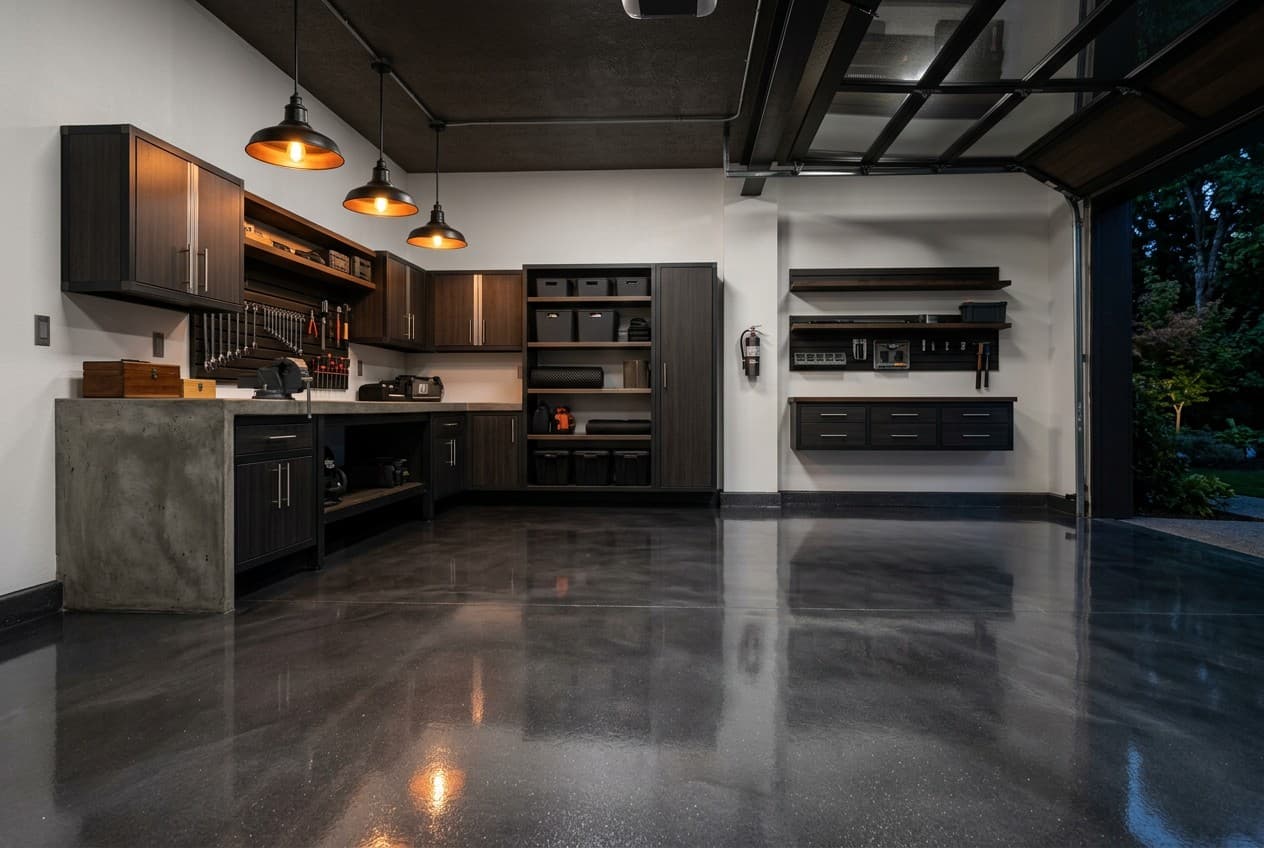
The Garage Floor Upgrade Most People Get Wrong
The garage floor is the first thing people see and the last thing they plan for. Most homeowners either choose concrete paint (cheap but peels within a year), or get talked into a professional epoxy install (expensive but often unnecessary for their use case).
There are five viable garage flooring options in 2026. They vary by cost, durability, installation complexity, and how they handle the two things that destroy garage floors: hot tire pickup and moisture vapor transmission.
This guide compares all five options honestly — including what the showroom brochures leave out.
The Five Options — Side by Side
| Option | Cost/Sq Ft | DIY-FriendlyRecommended | Durability | Hot Tire Resistance | Best For |
|---|---|---|---|---|---|
| Concrete Paint | $0.15–$0.50 | Yes | 2–4 years | Poor — peels | Rentals, temporary, low traffic |
| Epoxy Coating (DIY) | $2–$4 | Moderate | 5–10 years | Moderate — can peel in hot climates | Homeowners with prep skills |
| Interlocking Tiles | $2–$5 | Yes — easy | 10–20+ years | Excellent | Most garages — best value |
| Polyurea Coating | $4–$8 (pro) | Difficult — pro recommended | 15–25 years | Excellent | Long-term owners who want set-and-forget |
| Concrete Stain/Sealer | $1–$3 | Yes | 5–8 years | Good | Aesthetic upgrade without texture |
Option 1: Concrete Paint
The $0.15/sq ft option exists. You can buy a gallon of latex floor paint, roll it on your garage floor, and call it done. It will look good for about six months.
Concrete paint fails because it doesn't bond properly to concrete — it sits on top. Hot tire pickup (the chemical reaction between a hot tire and the coating) pulls the paint off in sheets. Moisture from beneath the slab pushes it up as bubbles. In most climates, you're repainting every 1–2 years.
Who it's for: renters who can't do permanent flooring, garages used purely for storage with no vehicles, or as a temporary solution while you save for a real coating.
Option 2: Epoxy Coating (DIY)
Epoxy is the most popular garage floor upgrade — and the most misunderstood. The two-part kits from home improvement stores ($80–$150 for a one-car garage) are real epoxy, but they're water-based epoxy, which is thinner, less durable, and more prone to hot tire peeling than 100% solid epoxy.
What makes DIY epoxy succeed or fail: surface preparation. The concrete must be acid-etched or mechanically ground (diamond grinder) before application. Skipping this step is why most DIY epoxy jobs fail within two years. With proper prep, a 100% solid epoxy kit ($200–$400 for a one-car garage) can last 8–12 years.
The real pros:
- Full custom look (flake broadcast, metallic, solid colour)
- Seamless and easy to clean
- Excellent chemical resistance
The real cons:
- Moisture vapor transmission (MVT) causes bubbling — must test your slab before applying
- 24–48 hour application window with no humidity
- 72-hour cure time before light traffic, 7 days before heavy
Epoxy Coating — Honest Assessment
- ✓Best-looking result of all options
- ✓Excellent chemical and oil resistance
- ✓Seamless — easy to sweep and mop
- ✓DIY-achievable with proper prep
- ✓Relatively low material cost
- ✗Hot tire peeling if water-based product used
- ✗Surface prep is non-negotiable and labour-intensive
- ✗Not suitable for slabs with high moisture vapor transmission
- ✗Fails faster in extreme hot/cold climates without UV-stable topcoat
- ✗Cannot be applied over existing paint or coatings
Option 3: Interlocking Tiles
Interlocking garage floor tiles are the best option for most homeowners — they're the easiest to install, the most forgiving, and they perform better than most people expect.
Polypropylene tiles (the perforated diamond or coin-pattern tiles, $1.50–$3/sq ft) snap together over existing concrete. No glue, no prep, no cure time. They're removable, repairable (replace individual tiles if one cracks), and handle hot tires, oil spills, and moisture better than most coatings.
For heavier use — gym, workshop, or parking with heavy vehicles — go with PVC tiles (solid, not perforated, $3–$5/sq ft). These are thicker, more rigid, and have better load-bearing capacity.
Installation time: one-car garage in 2–4 hours. Two-car garage in 4–6 hours. Zero special skills required.
Interlocking Tiles — Honest Assessment
- ✓Easiest installation of all options — no adhesive, no cure time
- ✓Repairable — replace individual tiles, not the entire floor
- ✓Hot-tire resistant (polypropylene won't peel)
- ✓Suitable over any concrete condition, including high-moisture slabs
- ✓Removable — ideal for renters or those who may change garage use
- ✗Less seamless aesthetic than coating options
- ✗Grout lines can collect dirt (trade-off for drainage)
- ✗Quality varies dramatically — budget tiles crack under heavy loads
- ✗Not suitable as a permanent gym floor under dropping weights without thick PVC or rubber
- ✗Can shift slightly on very smooth concrete — add adhesive tape perimeter if needed
Option 4: Polyurea Coating (Professional)
Polyurea is the professional-grade answer to every limitation of DIY epoxy. It's four times harder than epoxy, UV-stable (won't yellow), cures in 4 hours (not 72), and handles the hot tire problem that defeats most other coatings.
The catch: it's difficult to apply correctly without professional equipment, and the upfront cost is $3,000–$6,000 for a typical two-car garage ($4–$8/sq ft installed).
If you're in a home you plan to own for 15+ years, polyurea is the only coating you'll ever need. The math works out compared to reapplying cheaper coatings every 3–5 years.
Option 5: Concrete Stain and Sealer
Concrete stain (acid stain or water-based stain) penetrates the concrete and creates a mottled, variegated look that can't be replicated with paint. It doesn't sit on top — it becomes part of the slab, so it can't peel.
Applied with a penetrating sealer, it's a solid 5–8 year solution for a good-looking garage floor at reasonable cost ($1–$3/sq ft DIY).
Limitation: stain and sealer don't add texture or cushioning, and they don't hide concrete imperfections — they emphasize them. If your slab has significant cracks or staining, this option will look worse than painting.
Cost per Square Foot — Compared
Garage Flooring Cost per Square Foot (Installed)
Frequently Asked Questions
Can I install garage flooring over existing epoxy?
Interlocking tiles: yes. New epoxy or polyurea over old epoxy: generally no — adhesion is poor and failure is likely. The old coating must be stripped to bare concrete first.
What's the best garage floor for a workshop?
If you spend time standing on the floor, interlocking tiles or rubber mats (for specific work areas) are more comfortable than a hard coating. For workshop aesthetics and easier cleanup, epoxy or polyurea over a good tile section is a common combination.
Does garage flooring add home value?
It can. A professional polyurea or epoxy job is a selling point in most markets — it signals a well-maintained garage. Interlocking tiles are seen as a positive in home gym or workshop garages. Budget paint is a neutral at best.
How do I handle the gap at the door?
Most coatings and tile systems leave a slight gap at the garage door opening due to the threshold. For coatings: a polyurea-based threshold strip fills this. For tiles: purchase edge trim pieces from the same manufacturer.
Related Guides
- Garage Makeover Hub: Complete Guide — full garage transformation planning resource
- Garage Makeover Ideas — inspiration before you plan
- Garage Storage Systems — once the floor is done, tackle storage
Use the AI Garage Designer to get a personalised garage makeover plan — flooring, storage, and layout recommendations based on your specific space.
If you're flooring a garage gym rather than a general-purpose garage, the garage gym flooring guide covers the specific considerations for rubber mats, interlocking tiles, and impact protection that a workout space requires.