
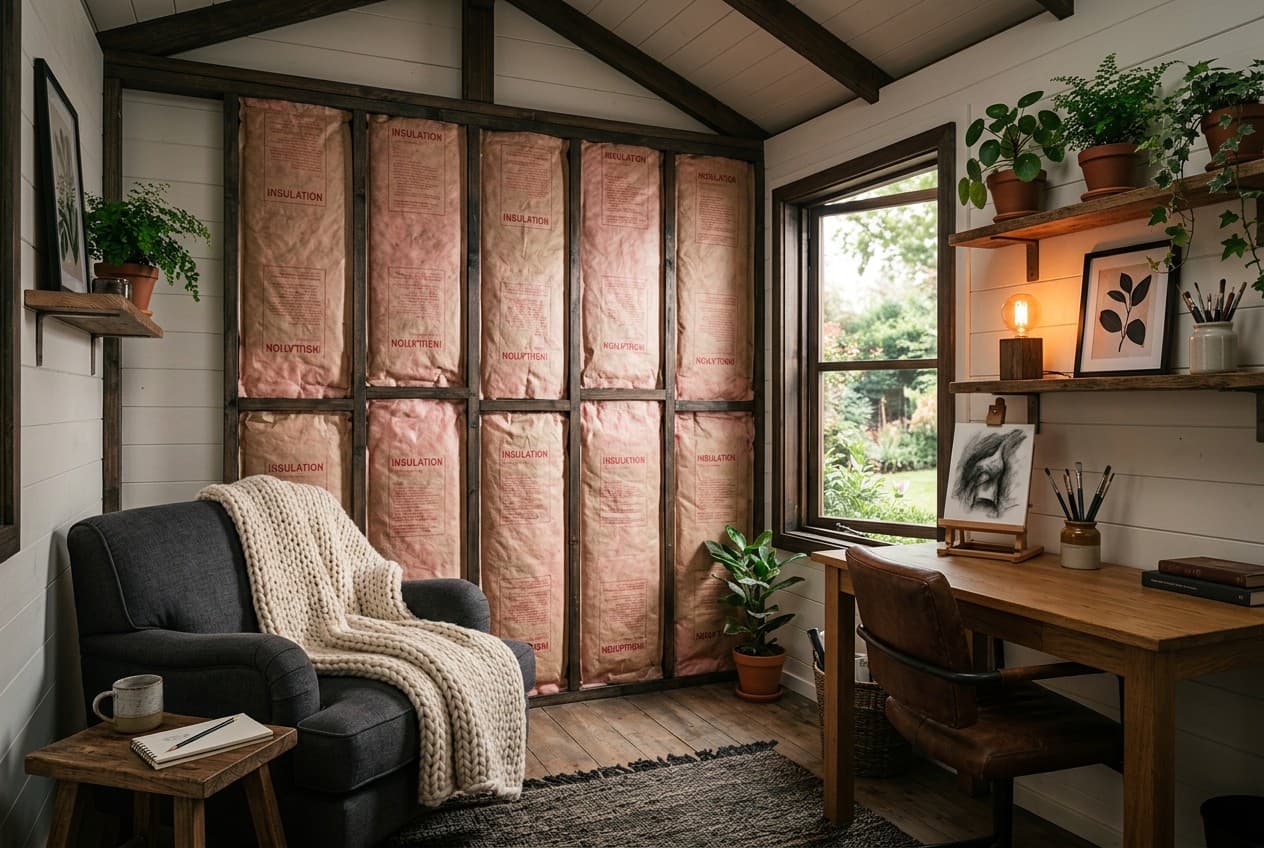
She Shed Insulation Guide: Stay Comfortable Year-Round (2026)
She Shed

She Shed Insulation Guide: Stay Comfortable Year-Round (2026)

She shed insulation options compared — fiberglass batts, rigid foam, spray foam, and reflective barriers. Which works for each shed type, with costs and the correct installation sequence.

By Michael McDonnell··2 min read
Disclosure: This article contains affiliate links. As an Amazon Associate and partner with other programs, we may earn a commission from qualifying purchases at no extra cost to you. We only recommend products we genuinely stand behind.

Why Insulation Is the Most Important She Shed Upgrade

An uninsulated she shed is comfortable for about four months of the year in most North American climates. In summer it overheats before noon; in winter it's too cold to use without heavy coats. The result: an expensive outbuilding used when the weather cooperates and abandoned the rest of the year.

Insulating properly turns a seasonal structure into a year-round room. It also reduces noise transmission, manages condensation (critical for shed longevity), and reduces heating and cooling energy requirements. Done correctly once, shed insulation lasts the life of the structure.


Insulation Methods Compared

MethodRecommendedR-Value/InchCost/Sq FtDIY FriendlyBest ForMain Limitation
Fiberglass battsR-3.2 to R-3.8$0.30–$0.60YesStud-framed walls (2×4 or 2×6) — standard fit, widely availableAir gaps reduce effectiveness; requires vapour barrier
Rigid foam (XPS/EPS)R-4 to R-6.5$0.60–$1.20YesFloors on concrete slab, thin walls, shed roofs with limited depthSeams must be taped; may require fire barrier covering
Spray foam (closed-cell)R-6 to R-7$1.50–$3.50No (pro only)Air sealing + insulation combined; irregular spaces, rim joistsHigh cost; professional application required
Mineral wool battsR-3.7 to R-4.2$0.50–$0.90YesBetter fire resistance than fiberglass; improved acoustic performanceHigher cost than fiberglass; slightly stiffer to cut
Reflective barrier (radiant)R-1 to R-2 (alone)$0.15–$0.40YesRoof/attic spaces in hot climates; reduces radiant heat gainIneffective in cold climates without additional insulation; minimal R-value alone
R-values per inch. Full wall R-value depends on cavity depth. A 2×4 stud wall (3.5 in cavity) with fiberglass batts achieves R-11 to R-13.

What R-Value Does a She Shed Need?

The required R-value depends on your climate zone (IECC zones 1–8) and the shed's primary use:

  • Zones 1–3 (warm/hot climates): R-11 walls, R-19 ceiling, R-4 floor. More important to manage heat gain than heat loss.
  • Zones 4–5 (temperate): R-13 walls, R-25 ceiling, R-11 floor. Balanced — both summer heat and winter cold are meaningful.
  • Zones 6–8 (cold/very cold): R-19 walls, R-38 ceiling, R-19 floor. Heating season dominates; vapour barrier on warm side is critical.

For a year-round comfortable she shed in a temperate climate, the minimum viable spec: R-13 walls, R-25 ceiling, R-11 elevated floor (or rigid foam on slab).


The Correct Installation Sequence

She Shed Insulation — Installation Order

1
Address moisture and air leaks first
Before any insulation goes in, caulk all gaps around the door frame, window frames, and any penetrations (electrical, pipes). A small air leak defeats good insulation. Use polyurethane caulk or expanding foam for gaps over 1/4 inch.
Note: Particular attention: the sill plate (where the wall framing meets the floor) and the top plate (where wall meets ceiling). These are the two most common infiltration paths in a shed.
2
Install floor insulation (if elevated)
For an elevated shed floor (floor joists over a crawl space), install R-11 or R-19 fiberglass batts between the floor joists from below, facing the vapour barrier toward the conditioned side (up). Use insulation supports or wire to hold batts in place — they should be snug, not compressed.
Note: On-grade slab: install 1-inch XPS rigid foam over the slab, then 3/4-inch plywood subfloor over the foam. This prevents cold transfer and moisture wicking from concrete.
3
Install wall insulation
For 2×4 stud walls: R-13 fiberglass batts or mineral wool. Cut to fit snugly — no compression, no gaps. For 2×6 walls: R-19 or R-21. Vapour barrier (6-mil poly or kraft-faced batts) goes on the warm side of the insulation (interior side in cold climates).
Note: Stagger cuts around electrical boxes — do not compress insulation behind or in front of boxes. Cut batts in half lengthwise to fill the narrow cavity beside boxes.
4
Insulate the ceiling
For flat ceiling with attic above: lay R-25 to R-38 fiberglass batts or blown insulation between ceiling joists. For a shed with roof rafters only (no attic): use closed-cell spray foam on the underside of the roof deck (R-20 min) or rigid foam board between and over rafters.
Note: Do not block the eave vents if the roof is vented — maintain the ventilation channel above the insulation. Use insulation baffles at the eaves.
5
Install vapour barrier
6-mil polyethylene sheeting over the wall insulation, on the interior (warm) side. Overlap seams by 12 inches. Tape seams with acoustic sealant tape. The vapour barrier also improves air sealing — every gap in the drywall or panelling that can be sealed with barrier adds up.
Note: In hot-humid climates (zones 1A–3A), the vapour retarder belongs on the exterior side, not the interior side. The rules flip in cooling-dominant climates.
6
Cover with interior finish
1/2-inch drywall, T1-11 panelling, or tongue-and-groove boards over the vapour barrier and framing. The finish provides the required fire rating for the insulation (most batts require a thermal barrier — drywall provides it).

She Shed Insulation — Cost by Method (10×12 Shed)

Costs for a 10×12 shed (approx. 320 sq ft wall/ceiling area). DIY labour only — professional installation adds 50–100% to material costs.

Heating and Cooling

Insulation without climate control is incomplete. For year-round she shed use, the practical heating/cooling options:

  • Mini-split (ductless heat pump): The correct solution for year-round use. Heats and cools efficiently. One head unit for a 10×12 to 12×16 shed (6,000–9,000 BTU). Installed cost: $1,500–$2,500. Requires a dedicated electrical circuit.
  • Electric panel heater: Wall-mounted electric baseboard or panel heater for heating only. 1,500W is adequate for a well-insulated 120 sq ft space. Low upfront cost ($80–$200) but higher operating cost than a heat pump.
  • Portable AC + space heater: The budget solution. A portable AC unit ($150–$350) for summer; an electric space heater ($40–$80) for winter. Less efficient, more obtrusive than a mini-split, but adequate for moderate climates.

Use the AI Garage Designer to plan your she shed layout — insulation spec, HVAC placement, and interior zone configuration for your specific shed dimensions and climate.

Free AI Tool

What could your garage become?

Upload a photo and get a personalised transformation plan in 60 seconds — free, no account required.

Try the AI Designer →
She Shed

Related Articles

She Shed

Best She Shed Kits and Prefab Options (2026)

Best she shed kits and prefab structures compared — wood, metal, and vinyl, at three budget levels. Scenario-matched recommendations for the most common she shed use cases.

Read article
She Shed

She Shed Decorating Ideas: Styles and Themes That Work (2026)

She shed decorating ideas by style — cottage, boho, minimalist, garden studio, and maximalist. Zone layouts and design principles for each approach, with what actually works in a small structure.

Read article
She Shed

She Shed Ideas: Layouts, Budgets & Design for 2026

Practical she shed ideas for 2026 — three zone layouts, a full budget breakdown, and the infrastructure decisions that determine whether your she shed is usable year-round.

Read article
She Shed

She Shed Office Ideas for Working From Home (2026)

She shed office layouts for remote workers — from dedicated home offices to craft-office combos. Includes zone plans, space dimensions, and budget tiers for building a backyard workspace that's actually yours.

Read article
She Shed

She Shed Ideas: The Complete Planning Guide for 2026

Transform your backyard shed or garage into the perfect she shed — a personalised retreat for crafting, gardening, relaxing, working, or creating. Full planning guide.

Read article
She Shed

Small She Shed Ideas That Maximize Every Square Foot (2026)

Small she shed ideas for 8×10 to 12×16 structures — layout strategies, zone configurations, and dimension rules that make a compact space feel intentional and genuinely usable.

Read article

About The Author

MM

Michael McDonnell

Mechanical Engineer · 10+ years construction & fabrication

Founder of The Tool Scout. Every recommendation on this site is based on hands-on experience building workshops, garages, and fabrication spaces — not spec sheets.

More about Michael →