
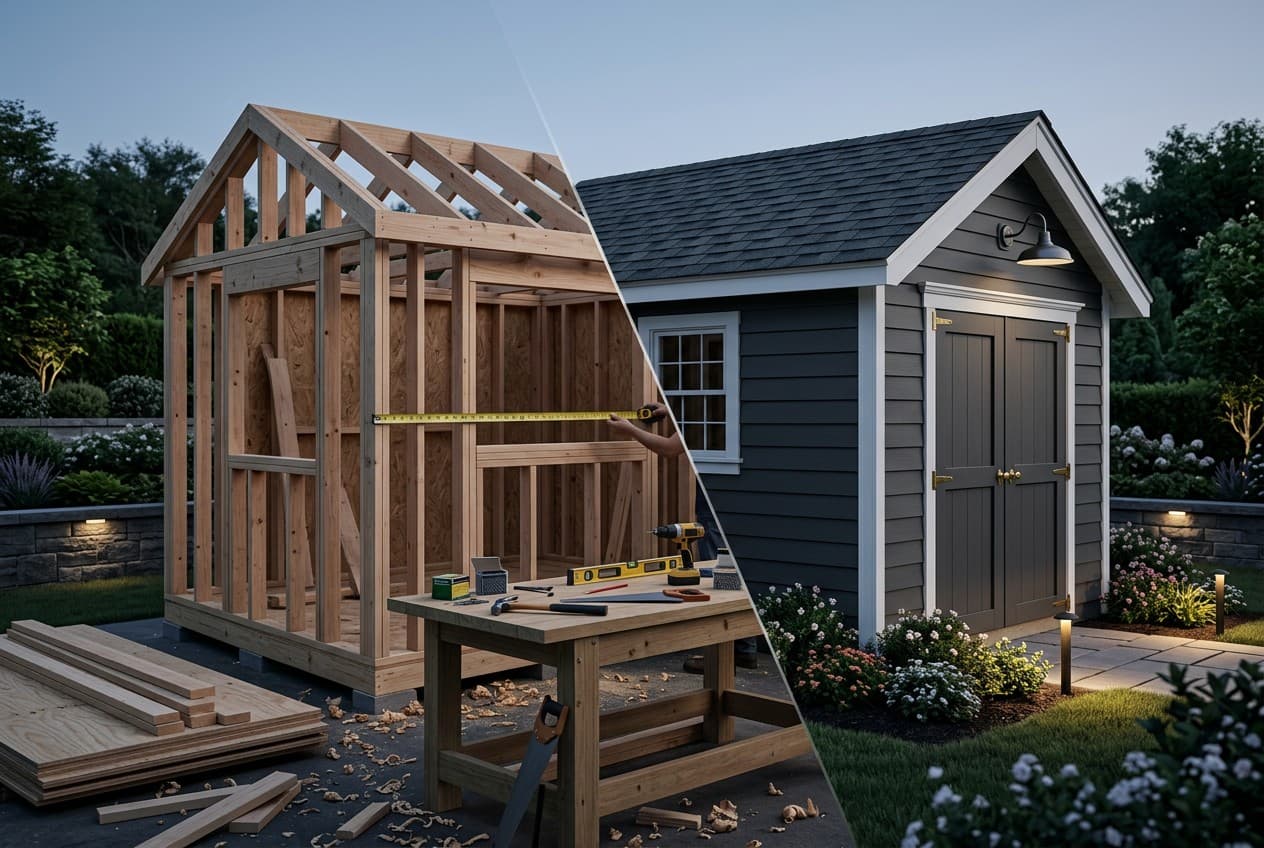
The decision to build or buy a shed is rarely just about money. It comes down to what you can realistically pull off — your skill level, how much time you're willing to invest, and whether you want a weekend project or a finished structure in your yard by next month.
There are four meaningful ways to get a shed: build from scratch using plans, assemble a pre-cut kit yourself, order a prefab unit delivered and placed, or hire a contractor to build exactly what you want. Each option has a distinct cost profile, skill demand, and timeline. The right one depends on which of those factors matters most to you.
This guide breaks down all four methods so you can make the call with clear eyes.
How the Four Methods Compare
Start with the side-by-side. The table below covers the essential tradeoffs for each approach.
| Build Method | CostRecommended | Key Benefit | Main Drawback | Best For |
|---|---|---|---|---|
| DIY from plans | $1,500–$4,000 | Lowest cost, full customization | Requires carpentry skills and tools | Experienced DIYers |
| Kit shed (self-assembled) | $2,000–$6,000 | Pre-cut parts, clear instructions | Limited customization | Confident DIYers |
| Prefab delivered | $3,500–$10,000 | No build required | Site prep required, delivery access needed | Most homeowners |
| Contractor built | $6,000–$20,000+ | Best quality and customization | Highest cost, requires permits | Large or complex sheds |
Cost at a Glance
To put raw numbers in context, here's what each method typically costs for a standard 12×16 ft shed — the most common size for a storage or hobby shed.
Shed Build Cost by Method (12×16 ft)
Prefab Delivered: The Best Option for Most Homeowners
For the majority of homeowners — those without strong carpentry experience, with limited free weekends, or who simply want a quality result without the risk of a DIY build going sideways — a prefab delivered shed is the standout choice. Here's why.
Prefab Delivered Shed — Pros & Cons
- ✓No building skills required
- ✓Installed in one day
- ✓Warranty typically included
- ✓Wide size and style options
- ✗More expensive than DIY or kit
- ✗Site must be prepared (level pad, access for delivery truck)
- ✗Customization limited to available options
Prefab sheds are built in a factory, transported on a trailer, and placed on your prepared site. The whole installation usually takes a few hours. The main constraint is access — delivery trucks need a clear path (typically 10–12 ft wide) and a reasonably flat yard. If you have a tight gate or sloped property, confirm access with the supplier before ordering.
Permits and Site Prep: What Every Method Requires
Regardless of which build method you choose, two things apply universally: your shed needs a level base, and anything over roughly 100–120 sq ft will very likely need a permit.
Site prep is non-negotiable. A shed placed on soft or uneven ground will shift, rack, and deteriorate faster. A gravel pad (4–6 inches of compacted gravel on a prepared base) is the most common and cost-effective solution, typically running $200–$600 for a 12×16 shed. Concrete slabs offer better permanence but cost more — typically $800–$2,000 depending on size and thickness.
Permits vary by jurisdiction, but the 100–120 sq ft threshold is a useful rule of thumb across many US states and Canadian provinces. Sheds used as habitable space (offices, studios) often require permits regardless of size. Some areas also have setback requirements that dictate how far the shed must be from property lines or fences. Check with your local building department before ordering or breaking ground — it's a one-call task that can save you from costly complications later.
Frequently Asked Questions
Do I need a permit for a shed?
In most jurisdictions, sheds under approximately 100–120 sq ft are exempt from building permits, though this threshold varies by city, county, and state. Larger sheds — and any shed used as a workspace or habitable structure — almost always require a permit. Some areas also require electrical permits separately if you're adding power. Always check with your local building department before starting; requirements and fees vary widely.
How long does it take to build a shed?
It depends entirely on the method. A prefab delivered shed is placed in a single day (once site prep is done). A kit shed typically takes one to three weekends for a competent DIYer. A DIY build from plans can take anywhere from two weekends to several months depending on complexity and how much time you can dedicate. Contractor-built sheds depend on the builder's schedule and permit timelines — budget four to twelve weeks from contract to completion in most markets.
Can I build a shed myself with no experience?
If you have zero carpentry experience, a full DIY build from plans is a significant stretch. You'd need to know how to cut lumber accurately, frame walls, build roof trusses, and apply roofing — not beginner territory. A kit shed is a more realistic entry point: parts are pre-cut, instructions are detailed, and the assembly sequence is clear. That said, even kit sheds require basic tools, comfort with a drill and nail gun, and at least one helper. If you have genuine doubts about your skills, a prefab delivered shed removes all the construction risk.
What to Do Next
Before you commit to a build method, size, or supplier, it's worth mapping out your space properly. The wrong size shed — too small and you'll outgrow it in a season; too large and it dominates your yard — is one of the most common and expensive mistakes.
Plan your shed project with the Garage Designer to visualize your space, test different shed sizes, and figure out what actually fits before you spend a dollar.
For more on shed office setups, layouts, and upgrades, see the full shed office guide.
Once you have your build method sorted, the next step is understanding the full numbers — how much it costs to build a shed covers materials, site prep, permits, and electrical so you can budget accurately. If your goal is an office rather than pure storage, shed office ideas shows what the finished space can look like at each budget tier.