
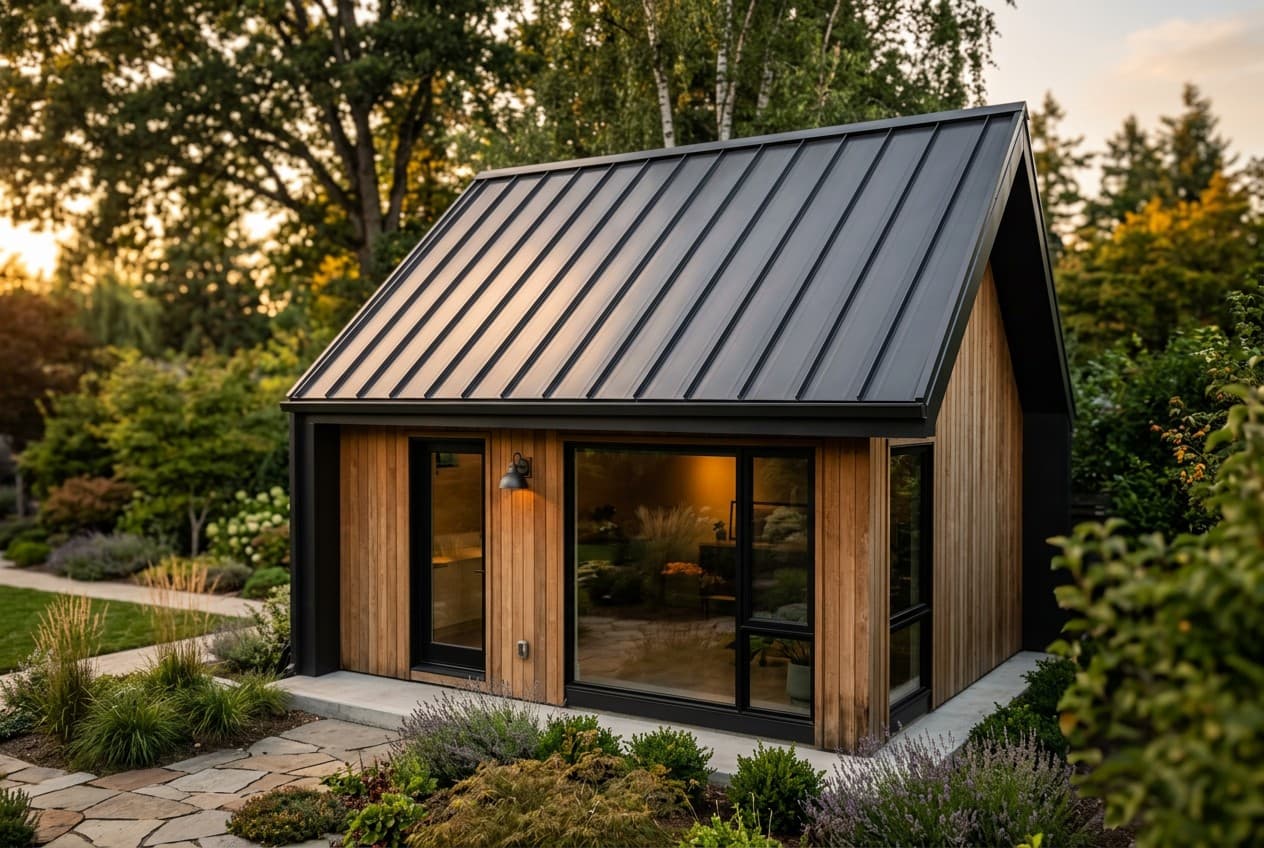
Roofing is the most important structural decision for a long-lasting shed. Get it wrong and you'll face leaks, rot, and costly repairs within a few years — often before you've recovered the cost of the build. Get it right and the roof becomes something you never think about again. The choice comes down to three factors: roof pitch, local climate, and whether you're installing it yourself. A roofing material that works perfectly on a steeply-pitched shed in the Pacific Northwest may be completely wrong for a flat-roof garden shed in Phoenix.
This guide compares the six materials that account for the vast majority of shed roofs built in 2026 — what each costs, how long it lasts, what pitch it needs, and whether it's a realistic DIY job.
Side-by-Side Comparison
| Material | Cost per sq ftRecommended | Lifespan | Min Pitch | DIY-Friendly | Best For |
|---|---|---|---|---|---|
| Asphalt shingles | $0.80–$1.50 | 20–30 years | 2:12 | Yes | Most shed builds — the practical default |
| Standing seam metal | $3.00–$6.00 | 40–70 years | 1:12 | Moderate | Premium sheds, long-term builds |
| Corrugated metal | $1.20–$2.50 | 25–40 years | 0.5:12 | Yes | Low-slope and utility sheds |
| EPDM rubber membrane | $1.50–$3.00 | 20–25 years | Flat | Yes | Flat roofs only |
| Cedar shakes | $2.50–$5.00 | 20–40 years | 4:12 | Moderate | Aesthetic builds, rural settings |
| Polycarbonate panels | $2.00–$4.00 | 15–20 years | 5:12 | Yes | Greenhouses, garden studios wanting natural light |
Cost Per Square (100 sq ft) by Material
Shed Roofing Cost per 100 sq ft (One Square)
Asphalt Shingles: The Standard Choice for Most Sheds
Asphalt shingles are the default roofing material for shed builds in 2026 for good reason — they're cheap, widely stocked at every hardware store, and straightforward enough for a first-time DIYer to install correctly in a day.
Asphalt Shingles — The Standard Choice
- ✓Lowest upfront cost of any shingle material
- ✓Widely available — stocked at every hardware store
- ✓Easy DIY installation with standard hand tools
- ✓30-year lifespan with architectural-grade shingles
- ✓Large range of colours to match the main house
- ✗Heavier than metal or rubber options — check existing roof structure
- ✗Not suitable for pitches below 2:12
- ✗Requires felt underlayment and drip edge for correct installation
- ✗Less energy-efficient than metal in hot climates
Use 3-tab shingles only on temporary or utility sheds — the money saved over architectural shingles is minimal and the lifespan difference is significant. On a shed you've invested time and money converting into an office or studio, architectural shingles are worth the small premium.
Metal Roofing: The Premium Alternative
Metal roofing has become significantly more accessible for DIY installation over the past decade. Corrugated panels in particular install quickly with basic tools, and the combination of long lifespan and low maintenance makes the higher upfront cost easy to justify on a shed you intend to keep for decades.
Metal Roofing — The Premium Alternative
- ✓Longest lifespan of common materials — 40–70 years for standing seam
- ✓Extremely low maintenance once installed
- ✓Handles all climates well — snow sheds easily, reflects heat in summer
- ✓Corrugated panels work on very low slopes (0.5:12)
- ✓Fire-resistant
- ✗Higher upfront cost than asphalt, especially standing seam
- ✗Expands and contracts with temperature — fasteners must accommodate movement
- ✗Noise during heavy rain (can be mitigated with solid decking below)
- ✗Standing seam requires more skill to install than corrugated panels
If noise is a concern — particularly for a shed office — install the metal over solid plywood decking with felt underlayment rather than directly over purlins. The decking layer absorbs the majority of rain noise.
Installation Notes: What Matters as Much as Material Choice
Choosing the right roofing material is only half the job. The detail work — underlayment, flashing, and edge treatments — is where most shed roof failures actually begin. The roofing material itself rarely fails first; leaks almost always start at the edges and joints.
Every shed roof needs three things regardless of material: a starter course at the eaves (to prevent water from wicking back under the first full course), proper drip edge on all four sides, and correctly installed step flashing at any wall or vertical surface the roof meets. Felt underlayment (or a synthetic equivalent) goes over the decking before any roofing material. These details cost very little and add years to the roof's effective life.
Flashing is the detail most DIYers skip or underdo. Where the roof meets a wall — at a lean-to addition, a dormer, or against the main house — step flashing bedded in roofing cement is non-negotiable. Self-adhesive membrane flashing tape is an acceptable alternative for small penetrations and low-slope transitions. Do not rely on sealant alone at any joint — it will fail within five years in most climates.
Frequently Asked Questions
What's the cheapest shed roofing?
Asphalt shingles are the cheapest shingle roofing option at around $80 per square (100 sq ft) for materials. Roll roofing — essentially asphalt in roll form without the individual shingle cuts — is even cheaper at $50–$70 per square and installs faster, but has a shorter lifespan (10–15 years) and a less finished appearance. For a flat or very low-slope roof, EPDM rubber membrane at $150 per square is the cheapest option that will actually perform correctly on a flat surface. Don't use asphalt shingles on slopes below 2:12 — they will leak.
Can I put metal roofing on a low-slope shed?
Yes, but the type of metal roofing matters. Corrugated metal panels can be installed on slopes as low as 0.5:12 with the correct lap distances and sealed fasteners. Standing seam metal (with concealed clips and no exposed fasteners) can also handle low slopes. Standard ribbed metal panels with exposed screws need at least a 3:12 pitch to prevent water from sitting around the fastener holes. Check the manufacturer's minimum pitch requirement for any product before purchasing.
How long do asphalt shingles last on a shed?
3-tab asphalt shingles typically last 15–20 years on a shed with adequate ventilation and no overhanging trees. Architectural (dimensional) shingles last 25–30 years under the same conditions. Shingles on shed roofs often degrade faster than on houses because sheds typically have less attic ventilation, which causes heat to build up under the roofing and accelerates shingle deterioration. Installing a ridge vent and at least one soffit vent significantly extends shingle life even on a small shed.
What to Do Next
Before you order roofing materials, use our garage designer to lay out your shed build — roof pitch, square footage, and overhang dimensions all affect your material quantities and your structural requirements.
For more on converting a shed into a usable office or studio, see our shed office guide.
Roofing is one piece of the overall build cost picture — how much it costs to build a shed covers the full breakdown including materials, site prep, and labour so you can budget the whole project. If you are still deciding whether to build from scratch or buy a pre-built structure, build vs buy a shed compares the options honestly across cost, skill required, and timeline.