
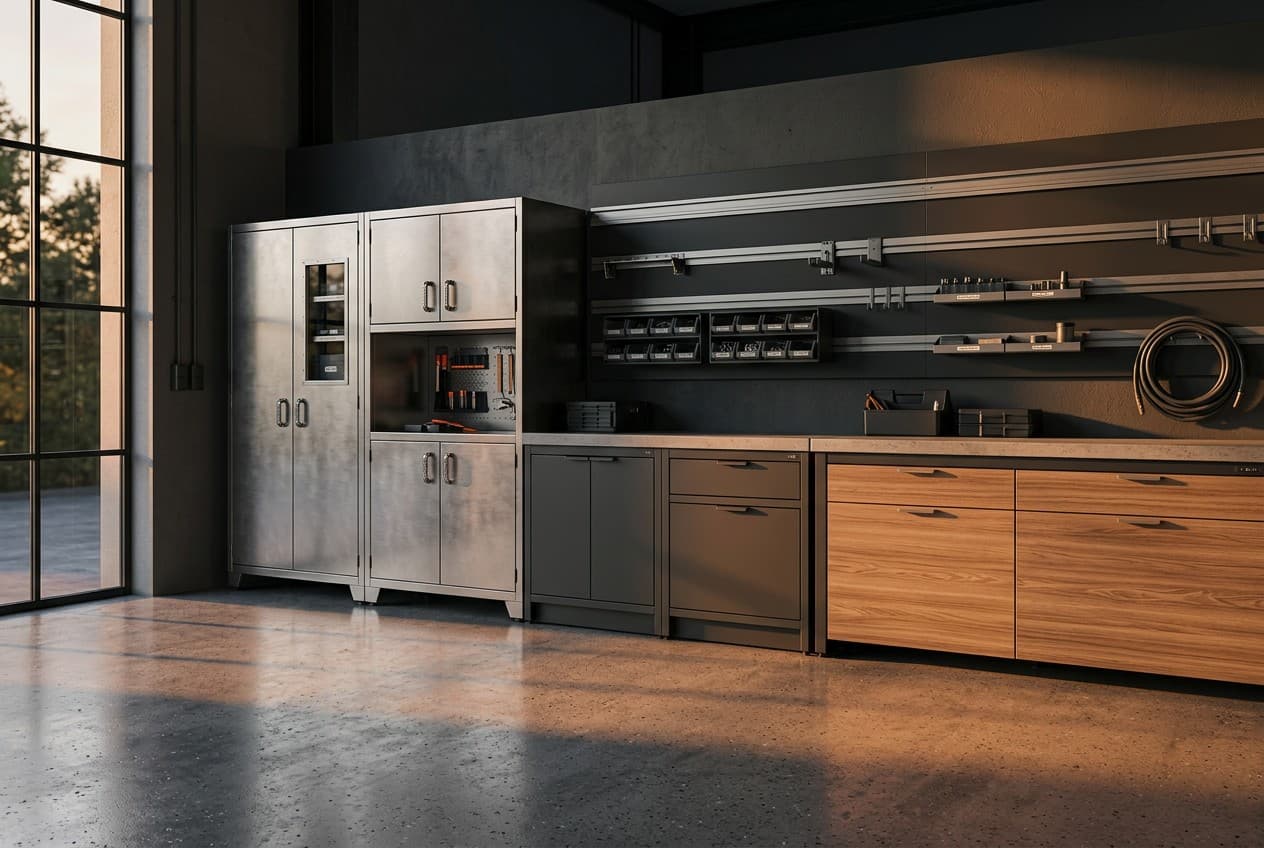
Why Garage Cabinets Outperform Open Shelving for Certain Storage
Open shelving is the most efficient use of garage wall space for bulk items — bins, boxes, seasonal gear. But open shelving has a real limitation: everything on it collects dust, is visible, and is accessible to anyone.
Cabinets solve three specific problems:
- Dust and debris protection — in an active garage workshop, sawdust and grinding sparks settle on open shelves within an hour of use
- Security — chemicals, power tools, and valuable equipment behind lockable cabinet doors
- Appearance — a garage with cabinet storage reads as finished and organised, not as a room full of stuff
The decision is not open shelving vs. cabinets — it's knowing which storage to put where. Heavy, uniform items (bulk materials, seasonal gear) belong on open shelving. Tools, chemicals, and frequently-accessed equipment belong in cabinets.
Scenario-Based Recommendations
Best Garage Cabinet for Your Use Case
Full Cabinet Comparison
| MaterialRecommended | Cost Range | Weight Capacity | Moisture Resistance | Appearance | Best For |
|---|---|---|---|---|---|
| Steel (powder-coated) | $200–$800/unit | 200–500 lbs/shelf | Good (rust risk if finish chips) | Premium — looks like installed cabinetry | Tools, workshop, finished garages |
| Resin/plastic | $150–$400/unit | 75–150 lbs/shelf | Excellent — no rust, fully waterproof | Basic — looks like a plastic cabinet | Sports gear, seasonal storage, outdoor-adjacent garages |
| Solid wood (unfinished) | $100–$300/unit | 150–300 lbs/shelf | Poor without sealing — swells in humidity | Warm, natural — takes paint or stain well | Interior garages, woodworking workshops |
| Melamine/particleboard | $80–$250/unit | 50–100 lbs/shelf | Poor — swells and delaminate with moisture | Clean, white — looks like kitchen cabinetry | Finished, climate-controlled garages only |
| Aluminium | $400–$1,200/unit | 200–400 lbs/shelf | Excellent — no rust, lightweight | Premium industrial look | Commercial or premium finished garages |
Steel vs Resin Cabinets — Which to Choose
- ✓Steel: higher weight capacity — handles tools and heavy equipment without shelf deflection
- ✓Steel: better finish quality — powder coat options in multiple colours, handles lockability
- ✓Steel: structural — can be bolted together in runs for a wall-unit appearance
- ✓Resin: fully moisture-proof — no rust, no swelling, tolerates spills and humidity
- ✓Resin: lighter — easier to move, reposition, and add without floor reinforcement
- ✓Resin: lower cost — equivalent storage volume for 40–60% less money than steel
- ✗Steel: rust risk if the powder coat is scratched and moisture contacts the substrate
- ✗Steel: heavier — full steel cabinet systems require solid mounting to the wall or floor
- ✗Steel: higher cost — a full-wall steel system costs 2–3× more than an equivalent resin system
- ✗Resin: lower weight capacity — not suitable for heavy tool storage or large plate loads
- ✗Resin: appearance — plastic cabinets look like plastic cabinets, regardless of brand
- ✗Resin: UV degradation over time if exposed to direct sunlight in unshaded garages
Layout and Installation Notes
Base cabinet height: standard garage base cabinets are 34–36 inches tall. This aligns with standard workbench height — a run of base cabinets can double as a workbench surface if topped with a 3/4-in plywood or butcher-block top.
Upper cabinets: mount upper cabinets at 54–60 inches from floor to cabinet bottom. This leaves a 18–24 inch workspace between base and upper cabinets — enough for tools, a drill charging station, or a small workbench area.
Securing to walls: garage cabinets (especially steel, when loaded) must be secured to wall studs, not drywall. Use 3-in lag bolts into studs minimum. An unsecured 200-lb loaded steel cabinet is a tipping hazard.
Related Guides
- Garage Organization Ideas — full garage zone planning before any cabinet purchase
- Garage Tool Storage Ideas — dedicated systems for tools alongside or instead of cabinets
- Garage Shelving Ideas — open shelving options to pair with enclosed cabinets
- Garage Storage Hub: Complete Guide — the full planning resource
Use the AI Garage Designer to plan your garage storage wall — cabinet placement, open shelving zones, and floor configuration for your specific garage dimensions.