
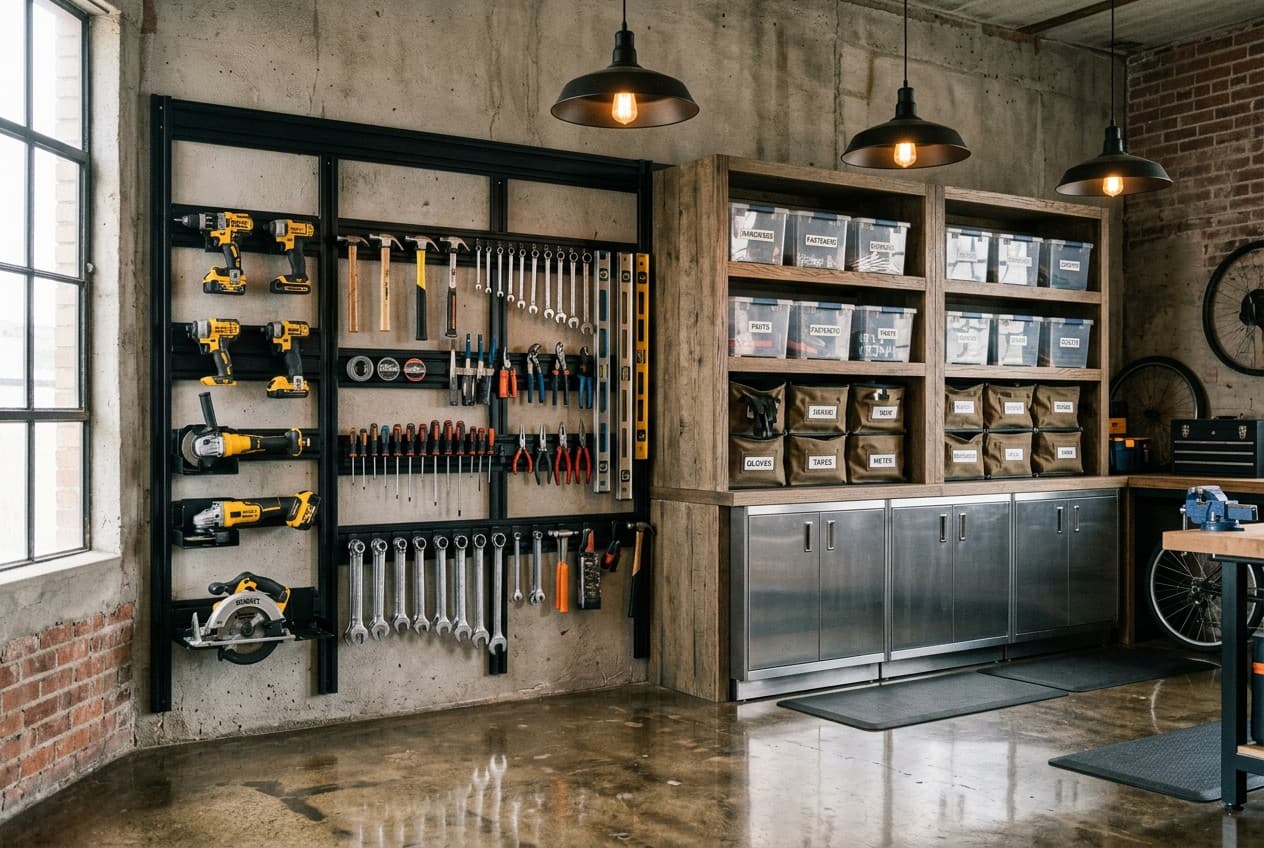
The Tool Storage Problem Most Garages Have
Tools live on a flat surface. Sometimes that surface is a workbench. Often it's the floor. Either way, you spend more time looking for what you need than actually using it.
The fix isn't more tools — it's a system that keeps every tool visible, accessible, and returned to its home after every use. The difference between a functional garage and a frustrating one is almost always about storage, not space.
This guide covers the four main wall storage systems, what each one is actually best for, and how to combine them based on the tools you own.
The Four Wall Storage Systems
French Cleat
A French cleat is a horizontal strip of wood cut at 45°, mounted to the wall. Holders made of the matching 45° profile hang anywhere on the cleat — and can be rearranged without tools.
Why DIYers love it: total flexibility. You make custom holders for every odd-shaped tool. The system grows with you. A full wall of French cleat costs $80–$150 in lumber (typically 1×4 or 3/4 inch plywood) and can be built in a weekend.
Best for: woodworking and construction tools, custom shop configurations, anyone who likes building their own storage. Not ideal if you want a turnkey system — you'll need to make or source the holders.
Pegboard
Classic 1/4-inch or 1/8-inch perforated hardboard. Cheap ($30–$80 for a 4×8 panel), universally available, and accepts a vast range of off-the-shelf hooks.
The limitation: standard pegboard hooks shift when you grab tools — leaving empty hooks that fall out when the board flexes. Fix: pegboard hook locks (clips that snap the hook to the board), or a 1/4-inch pegboard instead of 1/8-inch (stiffer).
Best for: small tool collections, rental garages, or supplementary storage alongside a primary system.
Slatwall
Pre-made horizontal channel panels accept a massive range of manufactured accessories — hooks, bins, shelves, basket brackets, bike holders. The ecosystem is enormous.
Advantage over pegboard: rigid, heavy-duty, holds more weight per hook. Advantage over French cleat: turnkey — purchase panels and accessories, install, done. No woodworking required.
Cost: $80–$150 per 4×8 panel installed. A full one-car garage back wall runs $200–$500 in panels before accessories.
Best for: homeowners who want a clean, polished system without building custom holders.
Cabinets
Steel utility cabinets, modular garage cabinet systems, or custom-built wood cabinets. Best for: chemicals, hazardous materials, items you want locked, hardware and small parts storage, and things you want hidden.
The trade-off: cabinets hide everything — including what you need to find quickly. Use cabinets for items accessed less than weekly; use open wall systems for daily-use tools.
Tool Storage by Category
Storage System by Tool Type
| Tool / Item | Use | Est. Cost | Priority |
|---|---|---|---|
| Hand tools (hammers, screwdrivers, wrenches) | Wall hooks or drawer organizer. Must be visible — drawers work if labelled | French cleat hooks: $20–$60 | Essential |
| Power tool bodies (drill, jigsaw, etc.) | Dedicated wall holder or drawer in rolling chest. Avoid stacking — damages triggers | $30–$100 per holder | Essential |
| Power tool batteries | Charging station on wall or bench — this is the most-accessed storage in a DIY garage | $40–$150 for a multi-bay station | Essential |
| Circular blades and saw blades | Blade organizer box or wall-mounted blade rack. Never loose in a drawer | $20–$50 | Essential |
| Clamps | Horizontal bar or French cleat clamp rack. Clamps stacked = clamps you can't grab | $15–$40 in hardware | Recommended |
| Measuring tools (tape measures, squares, levels) | Pegboard hooks at eye level. Small items lost in drawers — keep them visible | $10–$30 in hooks | Recommended |
| Hardware (screws, bolts, anchors) | Bins: wall-mounted bin rails or deep drawer organizer. Label every bin | $30–$100 for a bin system | Recommended |
| Extension cords and hoses | Wall-mounted cord reel or large J-hooks. Never coiled on the floor | $20–$80 per reel/hook | Recommended |
| Sanding supplies and consumables | Cabinet shelf or labeled bins — consumables degrade and need to be rotatable | $20–$50 in bins | Optional |
| Tall items (brooms, shovels, rakes) | Tool holders (spring-loaded wall mount) — keeps them upright without falling | $15–$40 for a 5-tool holder | Optional |
System Comparison
| System | Cost (One Wall)Recommended | Flexibility | DIY Difficulty | Weight Capacity | Best For |
|---|---|---|---|---|---|
| Pegboard | $50–$150 | Medium | Easy | Low–Medium (50 lb/sq ft) | Small tool collections, supplements |
| French Cleat | $80–$200 | High — rearrange anytime | Medium (woodworking required) | High (200+ lb/sq ft) | Workshop, custom tool collections |
| Slatwall | $250–$600 | Medium–High | Easy (screw to studs) | High (100–200 lb/sq ft) | Clean finished look, no woodworking |
| Steel Cabinets | $200–$800 | Low — fixed shelves | Easy | Very high (2,000+ lb) | Chemicals, small parts, hidden storage |
| Rolling Tool Chest | $200–$800 | High — mobile | None (assemble) | Very high | Power tools, sockets, hand tools |
French Cleat vs Slatwall — The Main Decision
- ✓French cleat: lowest material cost ($80–$200 for a full wall)
- ✓French cleat: unlimited customization — make any holder you need
- ✓Slatwall: turnkey installation — no woodworking required
- ✓Slatwall: massive off-the-shelf accessory ecosystem
- ✗French cleat: requires woodworking skills to make custom holders
- ✗French cleat: raw wood appearance unless you paint/finish
- ✗Slatwall: significantly more expensive than French cleat
- ✗Slatwall: panels can bow if not properly backed and mounted to studs
Rolling Tool Chests
For power tools, sockets, and hand tools you use weekly, a rolling chest (or combination chest + cabinet) is often the highest-ROI storage addition to a small garage.
The advantages over wall storage: mobile (bring to the project location), secured (lockable drawers), and accessible without needing to identify a specific wall hook or holder.
Chest sizing for DIYers:
- 26-inch chest (3–5 drawers): adequate for a casual DIYer with one power tool kit
- 41-inch chest (7–10 drawers): suits an active home shop
- 52+ inch combination unit: serious workshop standard
The chest lives under or beside the workbench — it doesn't take floor space the way freestanding shelving does.
The Labelling Principle
Every storage position needs a label. Not just the drawers — the wall hooks, the bins, the cabinet shelves.
Without labels, "a home for everything" gradually reverts to "wherever it fits." The label is the commitment that the tool lives here and gets returned here.
Use a label maker or printed-and-laminated labels, not handwritten tape. Tape peels. Permanent labels stay.
Related Guides
- Garage Organization Ideas — zone planning before you install storage
- Overhead Garage Storage Guide — ceiling racks and hoists
- How to Organize a Tool Chest — the inside of the rolling chest
- Garage Storage Hub: Complete Guide — full storage planning resource
Use the AI Garage Designer to plan your garage storage layout — wall systems, zones, and specific storage recommendations for your tool collection and garage size.
If some of your tools live in a shed rather than the garage, the tool shed ideas guide covers storage configurations and layout approaches specifically suited to dedicated outdoor tool storage structures.