
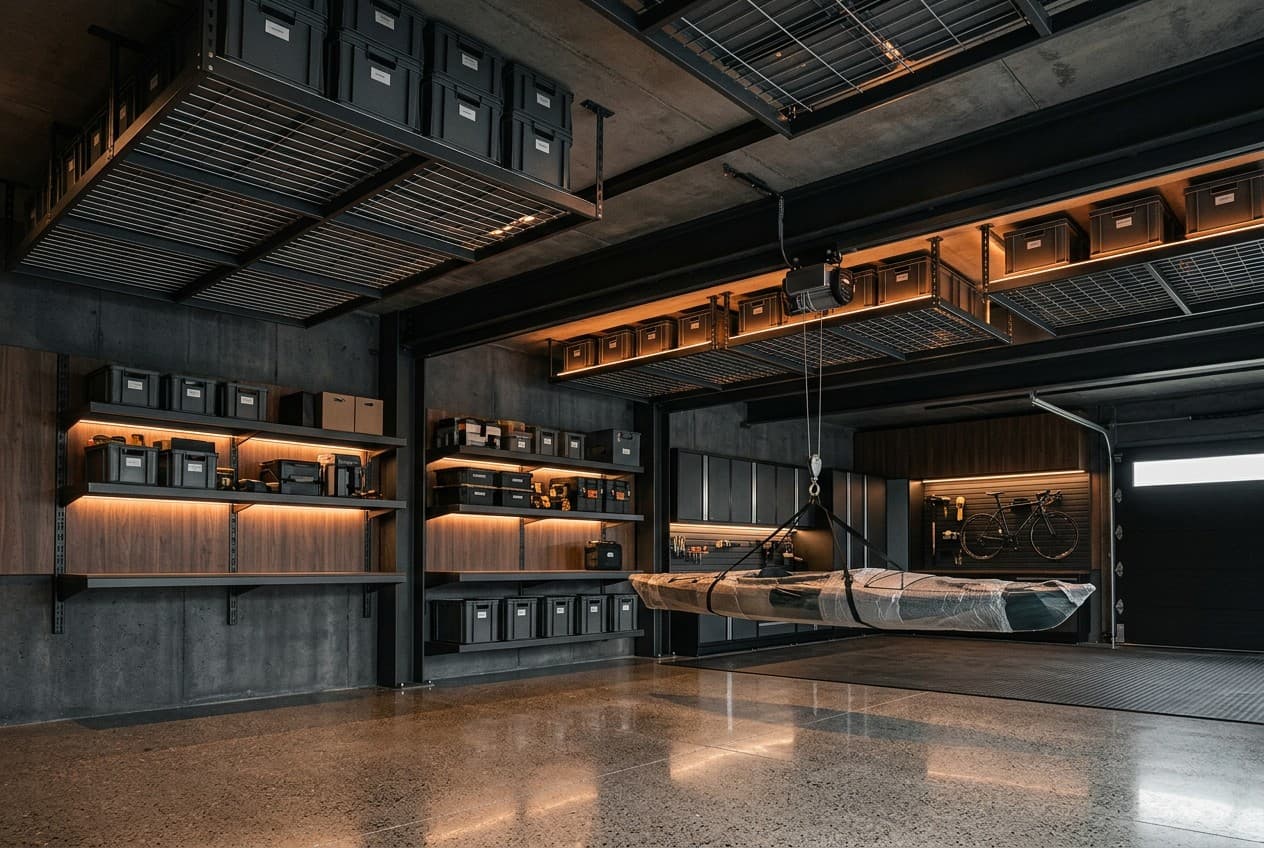
Why Overhead Space Is the Most Underused Storage in Most Garages
The average two-car garage has 400–500 square feet of floor space — most of which is already claimed by cars, workbenches, and floor-level shelving. What remains mostly unused: the 8–10 feet of vertical space above the car roofline.
Overhead storage systems reclaim that space without touching the floor. Done right, they hold seasonal items, rarely-used equipment, and bulky gear that otherwise displaces functional floor storage.
This guide compares the main overhead storage systems — what each costs, what it holds, and what it's suited for.
| System | Weight LimitRecommended | Cost Range | Best For | Main Limitation |
|---|---|---|---|---|
| Ceiling-mounted platform (fixed) | Up to 600 lbs | $150–$500 installed | Bulky seasonal items, totes, bins | Items hard to reach — need a ladder for everything |
| Motorised lift platform | Up to 250 lbs | $400–$900 installed | Kayaks, rooftop boxes, bikes | Higher cost; needs ceiling clearance for motor |
| Overhead pulley hoist (manual) | Up to 125–250 lbs | $50–$180 | Single bikes, ladders, lumber | One item per hoist; requires anchor point |
| Wall-mounted overhead track | Up to 300–500 lbs | $120–$350 | Bikes, tools, large bags in organised zones | Needs solid wall studs; limited depth |
| DIY plywood shelf platform | Up to 400+ lbs | $80–$200 materials | Budget overhead storage, totes | Labour intensive; requires accurate joist placement |
System 1: Fixed Ceiling-Mounted Platforms
The most common overhead storage solution. A metal grid platform suspends from the ceiling joists on adjustable-height drop rods. Depth: typically 48 inches. Width: 48–96 inches. Height above floor: adjustable from 20 inches to 84 inches.
What it holds: plastic storage totes, camping gear, holiday decorations, insulation rolls, seasonal furniture cushions. Essentially anything that fits in 18-gallon totes and isn't accessed weekly.
Installation: lag bolts into ceiling joists (not drywall anchors). Locate joists with a stud finder before buying — joists at 24-inch spacing limit where drop rods can go. Standard platforms come with hardware for joist spans; custom spans require additional hardware.
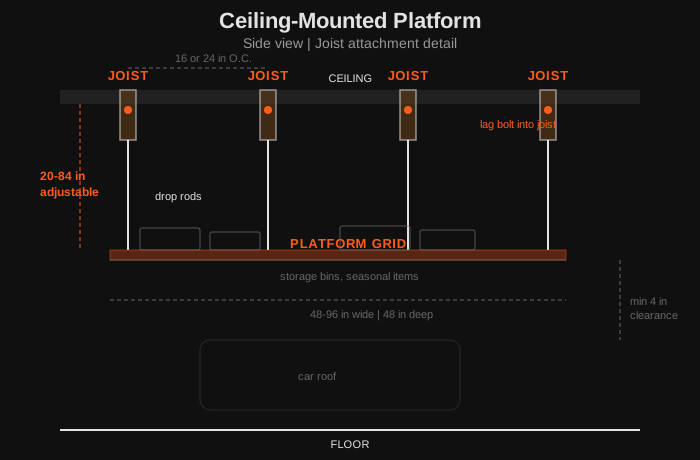
Best brands: Fleximounts, Proslat, Overhead Garage Storage. Fleximounts racks are the reliable mid-tier choice — consistent joist spacing hardware, clean powder coat, 600 lb total weight rating.
What to avoid: cheap big-box store kits with inadequate drop rod hardware. The platform itself isn't the failure point — the mounting hardware is.
Overhead Storage Systems — Cost Comparison
System 2: Motorised Lift Platforms
A motorised overhead platform uses a worm-drive motor to raise and lower a shelf platform via steel cables. You press a button — the platform descends to chest height, you load or unload, press again, it rises out of the way.
The practical use case is narrow: large, heavy items that are awkward to hand-load onto a fixed platform. The clearest fits:
- Rooftop cargo boxes (Thule, Yakima) — loaded and stored seasonally
- Kayaks and paddleboards — raised, horizontal
- Large seasonal equipment (camping gear in duffle bags, not totes)
Installation: 4 ceiling joist mounts, motor housing mounts to wall, cable system connects. DIY-possible but wiring the motor to a wall switch requires comfort with basic electrical. Most manufacturers supply detailed instructions; budget 3–4 hours.
Clearance requirement: the motor housing requires approximately 12 inches above the platform when raised. In an 8-ft ceiling garage, this limits the raised height and maximum loaded depth.
Best brands: Racor (PHL-1R), Garage Smart, Versarack. Racor is the most established at the consumer level.
System 3: Overhead Pulley Hoists
A simpler and cheaper system. Two pulleys mount to the ceiling; a cable system lets you raise a single object — a bike, a canoe, a ladder — and lock it in place overhead.
Per-hoist capacity: 100–250 lbs depending on model. For bikes, one hoist per bike.
What it does well: bikes stored out of the way for 6+ months, a kayak or paddleboard stored horizontally when not in season, lumber stored overhead in a small workshop.
Limitations: one item per hoist, no platform flexibility, requires a dedicated anchor point for each item. If you have 4 bikes, that's 4 separate installations.
Cost: $40–$80 per hoist (Rad Cycle, Racor, StoreYourBoard). For a 2-bike setup: under $150 total. Hard to beat per dollar for the specific use case.
System 4: Wall-Mounted Overhead Track
Track-based systems (Rubbermaid FastTrack, Proslat, Gladiator GearTrack) mount to wall studs and accept modular hooks, baskets, and shelves. Positioned higher on the wall — above the bonnet height of the car — they create organised overhead zones without touching the ceiling.
What they hold well: bikes (vertical hooks), tools (hooks), sports equipment, large bags, and baskets for loose items.
What they don't replace: the raw storage density of a ceiling-mounted platform for totes and boxes. Track systems are better at organised, frequently-accessed items than bulk storage.
Installation: requires solid studs. Check spacing before purchasing — most track systems require studs at 16 or 24-inch spacing to mount securely.
Fixed Platform vs. Motorised Lift — Which to Choose
- ✓Fixed platform: higher weight capacity (up to 600 lbs vs 250 lbs motorised)
- ✓Fixed platform: significantly lower cost — $150–$400 vs $400–$900
- ✓Fixed platform: no moving parts to maintain or fail
- ✓Motorised lift: accessible without a ladder — load at chest height
- ✓Motorised lift: ideal for heavy seasonal items (rooftop boxes, kayaks) used a few times per year
- ✓Motorised lift: stores items completely out of the visual space when raised
- ✗Fixed platform: everything accessed by ladder — impractical for items used more than monthly
- ✗Fixed platform: can accumulate clutter if not disciplined about what goes up
- ✗Motorised lift: lower weight capacity limits what it can realistically hold
- ✗Motorised lift: motor mechanism requires maintenance; cable wear over time
- ✗Motorised lift: clearance requirements limit utility in lower-ceiling garages (under 9 ft)
Installation Requirements
Before purchasing any overhead system, confirm:
-
Ceiling joist location and spacing. Use a stud finder and mark joists. Most residential garages have joists at 16 or 24-inch spacing. Some older garages have 12-inch spacing. Know this before ordering hardware.
-
Joist direction. Ceiling joists run across the narrow dimension of most garages (side to side). Overhead platforms typically mount perpendicular to joists. Confirm the orientation works for your space.
-
Ceiling height and car clearance. The platform must clear the tallest vehicle's roof — typically at least 4 inches of clearance. An 8 ft ceiling, 6 ft car roof = 24 inches of overhead space. A standard platform at 8-inch depth needs to be mounted 2+ ft above the car.
-
Attic access. If the garage has a finished ceiling with attic above, structural blocking may be needed before mounting heavy overhead systems.
Related Guides
- Garage Organization Ideas — full garage zone planning, including floor-level storage
- Garage Shelving Ideas — wall and floor shelving options to pair with overhead storage
- Garage Tool Storage Ideas — dedicated tool storage systems
- Garage Storage Hub: Complete Guide — the full planning resource
Use the AI Garage Designer to plan your full garage storage layout — overhead zones, wall systems, and floor storage configured for your specific garage dimensions.